Russian troops arriving in Marseilles, on France's Mediterranean coast, in April 1916. With the Dardanelles closed to them, they would have had a journey along the Atlantic coast of France, Spain, and Portugal before entering the Mediterranean at Gibraltar. Russian troops fought with the Allied forces on the Salonica and Western Fronts.
Les Troupes Russes a Marseille20 Avril 1916 — Défilé des Russes se rendant au Camp de MirabeauPhoto LlorcaRussians troops in Marseille April 20, 1916 — Column of Russians on their way to Camp Mirabeau
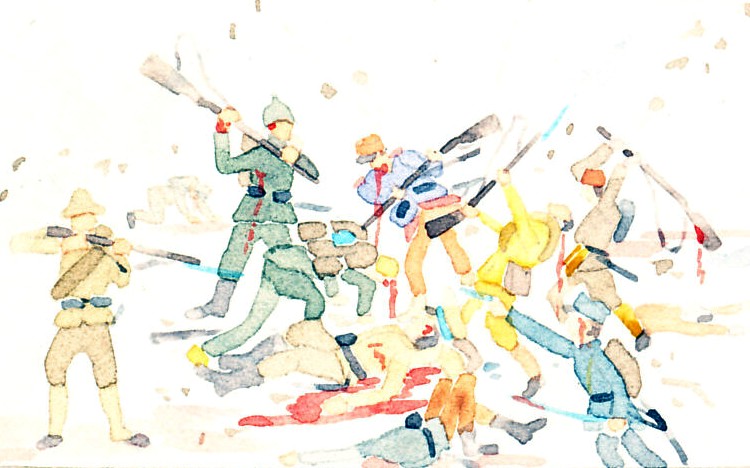
"There is great humiliation at General Headquarters and the War Ministry.The 2nd Russian brigade, which recently arrived in France and was about to embark for Salonica, has mutinied at Marseilles ; the colonel has been murdered and several officers were wounded. To restore order the vigourous intervention of French troops was required. Severe measures of repression have been taken and about twenty men shot.I cannot help remembering what Sazonov said to me last December when justifying his opposition to Doumer's request : 'When the Russian soldier is off his own soil he's worthless ; he goes to pieces at once.'"
Entry from the memoirs of Maurice Paléologue, French Ambassador to Russia, for Friday, September 1, 1916. Russian troops were already in the Allied line on the Salonica Front, having been transported from Archangel, Russia to Marseilles. The French wanted Russian troops serving with the French both because of the need for more men and for reasons of morale. In his memoir Poilu, Louis Barthas writes of seeing Russian troops, and of French speakers of Russian rapidly promoted and assigned as interpreters. Sergei Sazonov was Russian Foreign Minister from 1910 until his replacement by Boris Sturmer in July, 1916. Doumer was likely Paul Doumer, French Senator in the Chamber of Deputies, a former Minister and Governor-General of French Indo-China, and later President of France, assassinated by a Russian emigré in 1931. Paléologue met with him on December 4, 1915 and told the Ambassador he would ask Russia for 400,000 men.
An Ambassador's Memoirs Vol. III by Maurice Paléologue, pp. 16–17, publisher: George H. Doran Company
1916-09-01, 1916, September, Marseilles, Salonica, mutiny, Russian mutiny, execution