A Liebig bullion card from the series "Colonies of the European Powers" — The German colonies of Togo, Cameroon, and German East Africa, c1910.
Colonies des Puissances Européennes — AllemagneVillage au Cameroun.Lomé (Togo).Indegene du Cameroun.Femme de l'Est Africain.Véritable Extrait de Viande Liebig.Voir L’Explication au verso.Colonies of the European powersGermanyVillage in Cameroon.Lome (Togo).Indegene Cameroon.Woman in East Africa.Genuine Liebig Meat Extract.See the explanation on the back.Reverse:Capital 27,000,000 Francs.Établissements à Fray-Bentos (Uruguay) et Colon (Rép. Argentine).Le véritable Extrait de viande Liebig transforme les sauces les plus fades, les rests de viande, en choses succulentes qui flattent délicieusement le palais.Colonies des Puissances EuropéennesAllemagne - Les premiers essais colonisateurs de l'Allemagne datent de l'époque du Grand Electeur. Ils furent infructeux. Ce n'est qu'en 1884 qu'elle entra dans la voie de ses devancières en fait de colonization. Angre Pequena, dans le Sud-ouest africain, fut sa première colonie; suiverent successivement le Togo, le Cameroun, la partie orientale de la Nouvelle-Guinée, l'archipel de Bismarck. En 1885, elle agrandit ses possessions africaines par l'adjonction de territoires dans l'Est du continent noir et annexa les Iles Marshall et Samoa, dans l'Océanie; elle prit à bail pour 99 ans la baie et la ville de Kiao-tchéou, en Chine. Les viguettes du recto de cette carte donnent des vues des principales possessions allemandes en Afrique. La population des colonies allemandes s'élève à plus de 12 millions, répartis sur une surface total de 2 millions et demi de kilomètres carrés.Capital 27 million francs.Institutions Fray Bentos (Uruguay) and Colon (Rep. Argentina).The real meat extract Liebig transforms the most bland sauces, meat leftovers, into deliciously succulent things that flatter the palate.Colonies of the European powersGermany — The first German attempts at colonization date from the time of the Gre
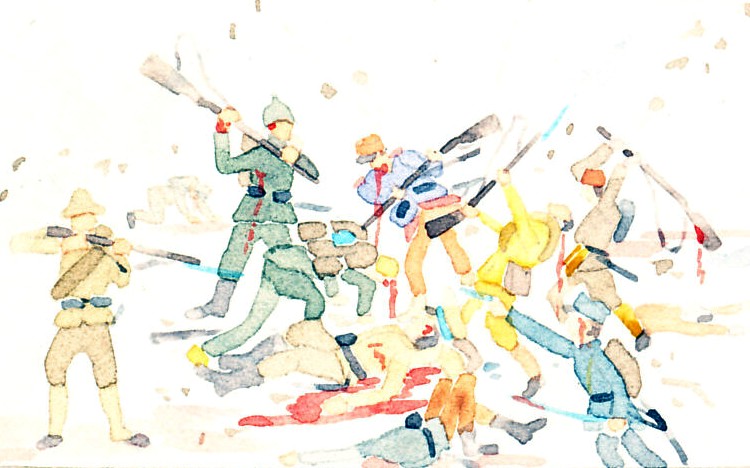
"At 5 p.m. we located four tents, fires burning and, by the mercy of God, no precautions, no sentries, and men lounging about. The country was good for stalking and we were well in position for a rush at dusk. In fact, the men having left their rifles in their tents and there being no sentry, we rushed them silently from not more than a few paces. We used bayonets only and I think we each got our man. Drought got three, a great effort. I rushed into the officers' tent, where I found a stout German on a camp bed. On a table was a most excellent Xmas dinner. I covered him with my rifle and shouted to him to hold his hands up. He at once groped under his pillow and I had to shoot, killing him at once. My shot was the only one fired.. . . After that excellent meal, I searched the German's kit: I have shot a Duke, the first Duke I have killed. . . ."
Excerpt from the December 28, 1915 diary of Richard Meinertzhagen, a British officer of German and Danish extraction pursuing the forces of German Lieutenant Colonel Paul von Lettow-Vorbeck in East Africa recounting the events of Christmas Day, the 25th. Karungu was in British East Africa on Lake Victoria, and very close to the border of German East Africa.
Intimate Voices from the First World War by Svetlana Palmer and Sarah Wallis, pp. 171, 172, copyright © 2003 by Svetlana Palmer and Sarah Wallis, publisher: Harper Collins Publishers, publication date: 2003
1915-12-28, 1915-12-25, 1915, December, Africa, East Africa