TimelineMapsSearch QuotationsSearch Images

Follow us through the World War I centennial and beyond at Follow wwitoday on Twitter


A Swiss postcard of 'The European War' in 1914. The Central Powers of Germany and Austria-Hungary face enemies to the east, west, and south. Germany is fighting the war it tried to avoid, battling Russia to the east and France to the west. Germany had also hoped to avoid fighting England which came to the aid of neutral (and prostrate) Belgium, and straddles the Channel. Austria-Hungary also fights on two fronts, against Russia to the east and Serbia and Montenegro to the south. Italy, the third member of the Triple Alliance with Germany and Austria-Hungary, declared neutrality, and looks on. Other neutral nations include Spain, Norway, Sweden, Denmark, Switzerland, Romania, Bulgaria, and Albania. Japan enters from the east to battle Germany. The German Fleet stays close to port in the North and Baltic Seas while a German Zeppelin targets England. The Austro-Hungarian Fleet keeps watch in the Adriatic. Turkey is not represented, and entered the war at the end of October, 1914; Italy in late May, 1915.

Text:
Der Europäische Krieg
The European War
Reverse:
Kriegskarte No. 61. Verlag K. Essig, Basel
Kunstanstalt (Art Institute) Frobenius A.G. Basel

A Swiss postcard of 'The European War' in 1914. The Central Powers of Germany and Austria-Hungary face enemies to the east, west, and south. Germany is fighting the war it tried to avoid, battling Russia to the east and France to the west. Germany had also hoped to avoid fighting England which came to the aid of neutral (and prostrate) Belgium, and straddles the Channel. Austria-Hungary also fights on two fronts, against Russia to the east and Serbia and Montenegro to the south. Italy, the third member of the Triple Alliance with Germany and Austria-Hungary, declared neutrality, and looks on. Other neutral nations include Spain, Norway, Sweden, Denmark, Switzerland, Romania, Bulgaria, and Albania. Japan enters from the east to battle Germany. The German Fleet stays close to port in the North and Baltic Seas while a German Zeppelin targets England. The Austro-Hungarian Fleet keeps watch in the Adriatic. Turkey is not represented, and entered the war at the end of October, 1914; Italy in late May, 1915.

Image text

Der Europäische Krieg

The European War

Reverse:

Kriegskarte No. 61. Verlag K. Essig, Basel

Kunstanstalt (Art Institute) Frobenius A.G. Basel

Other views: Larger, Larger
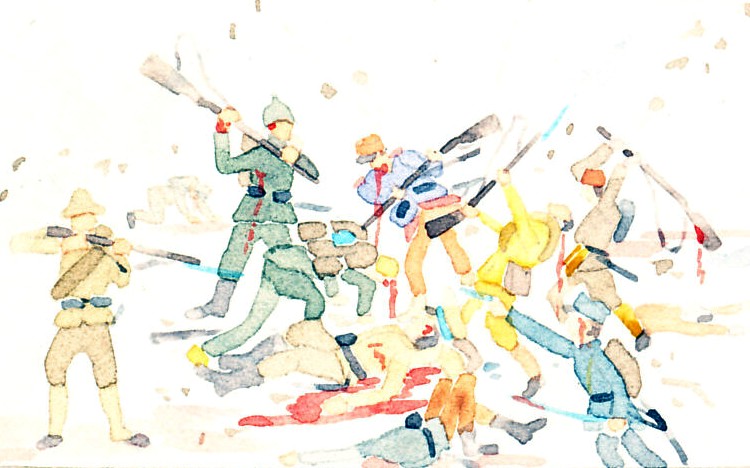
Monday, August 30, 1915

"The losses of the Russian army have been colossal. From 350,000 men a month in May, June and July, the figure has risen to 450,000 in August. Since the first defeat on the Dunajec the Russian army has thus lost approximately 1,500,000 men."

Quotation Context

Maurice Paléologue, French Ambassador to Russia, writing on August 30, 1915. He had met earlier with General Bielaïev, chief of the General Staff of the Russian Army. The German-Austro-Hungarian Gorlice-Tarnow Offensive — begun on May 2 on a line lying, in part, along the Dunajec River — had broken the Russian line, and the Russian army's retreat extended from the Baltic Sea to Romania. The ambassador also recorded that Russia was producing more shells and rifles, and importing more weapons, and that Moscow lay far from the front, that four armies defended the capital of Petrograd, and that autumn rains would soon slow the German advance. The two cities were likely safe.

Source

An Ambassador's Memoirs Vol. II by Maurice Paléologue, page 62, publisher: George H. Doran Company

Tags

1915-08-30, 1915, August, Paléologue, Paleologue, Petrograd, Petersburg