Examples of the uniform and kit of 'the modern Turkish soldier' from 'Ambassador Morgenthau's Story' by Henry Morgenthau, American Ambassador to Turkey from 1913 to 1916.
The Modern Turkish SoldierIn the uniform and equipment introduced by the Germans. The fez - the immemorial symbol of the Ottoman - is replaced by a modern helmet.
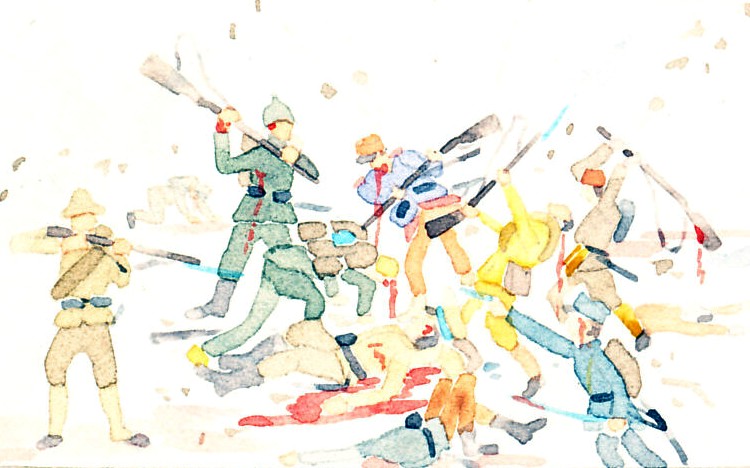
"Thus it was that on the two tragic days of 18 and 19 May 1915, young Turkish soldiers charged forward, to be mowed down by enemy artillery and machine guns before they could attempt to rush enemy trenches. Those who died on the spot were the lucky ones.Those who were maimed, crippled or so heavily wounded they could not move, lay on the battlefield, expecting the next shell, grenade or bullet to finish them off. The few who were eventually picked up by stretcher bearers were carried away for treatment, with the certainty that if they survived, they would soon be sent back to the front. And for what? Simply put, the greater glory of Enver Pasha and his cocky Divisional Commanders."
Excerpt from the account by Şefik Bey, commander of the 27th Infantry Regiment. of the Turkish offensive at Ari Burnu, Anzac Cove, on May 18 and 19, 1915. The Australian and New Zealand Army Corps (Anzacs) had entrenched (as best they could) on the hills above the beach at Ari Burnu. The Turkish attack of May 18 and 19 was the most concerted effort of the Gallipoli campaign to drive them into the sea. The 'cocky Divisional Commanders' led two newly trained divisions from Constantinople. When Turkish War Minister Enver Pasha asked them if they were prepared to launch an immediate offensive, they had both replied they were. In his memoir, Liman von Sanders, German commander of Turkish forces on the Peninsula, admitted the offensive was a mistake.
Gallipoli 1915; Day One Plus . . . 27th Ottoman Inf. Reft. vs. ANZACS; Based on Account of Lt. Col. Sefik Aker, Commander of 27th Infantry Regiment by H.B. Danisman, page 62, publisher: Denizler Kitabevi, publication date: 2007
1915-05-18, 1915, May, Gallipoli