Detail from Cram's 1903 Railway Map of the Austro-Hungarian Empire showing Transylvania.
Austro-Hungarian Monarchy.
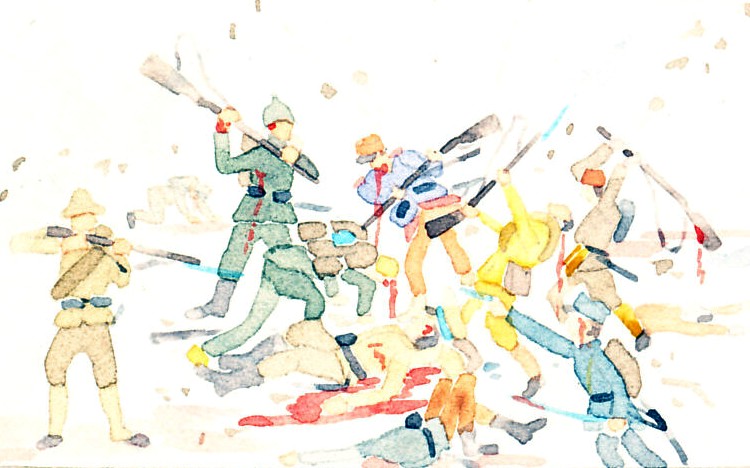
"On April 20th [1915], a band of Turkish soldiers seized several Armenian women who were entering the city; a couple of Armenians ran to their assistance and were shot dead. The Turks now opened fire on the Armenian quarters with rifles and artillery; soon a large part of the town was in flames and a regular siege had started. The whole Armenian fighting force consisted of only 1,500 men; they had only 300 rifles and a most inadequate supply of ammunition, while Djevdet had an army of 5,000 men, completely equipped and supplied."
In 1915, Van, Turkey was a city of about 35,000, the majority of the citizens Armenian, a population that spanned the Russo-Turkish frontier. At the beginning of the war, the Turkish government replaced the governor of Van with Djevdet Bey, brother-in-law of Turkish Minister of War Enver Pasha. The government claimed Armenians had supported the Russians both by joining them in the war against Turkey, and with intelligence when Russia and Turkey first clashed along their border. The Russian victory in the Battle of Sarikamish further poisoned the minds of Enver, Minister of the Interior Talaat, and other Turkish officials against the Armenians. The Turkish defeat of the Allied fleet in its attempt to force the Dardanelles and seize Constantinople convinced the government it had a free hand to turn on its Armenian citizens.
Ambassador Morgenthau's Story by Henry Morgenthau, pp. 298, 299, copyright © 1918, by Doubleday, Page & Company, publisher: Doubleday, Page & Company, publication date: 1918
1915-04-20, April, 1915, Armenia, Van,