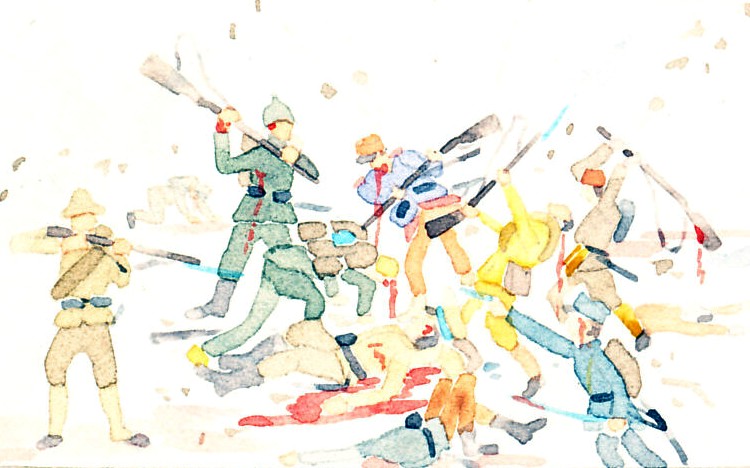
A hold-to-light postcard of the German and Austro-Hungarian victory (shortlived) over the Russians in the Uzroker Pass in the Carpathians on January 28, 1915. Franz Conrad von Hötzendorf, Chief of the Austro-Hungarian General Staff, launched an offensive with three armies on January 23, including the new Austro-Hungarian Seventh Army under General Karl von Pflanzer-Baltin.
KarpathenSiegreiche Kämpfe am Uzroker-Paß28. Januar 1915 The CarpathiansVictorious fighting at the Uzroker PassJanuary 28, 1915Reverse:Message dated and field postmarked September 7, 1916, 29th Infantry Division.
"They resumed the attack five days later, assaulting the same three-thousand-foot Russian-held heights they had stormed, taken, and lost the previous week. Snow that had been knee deep a few days earlier was waist deep now. Companies were down to a handful of men. By the end of January, the 6th Jäger Battalion, which had numbered 1,069 men on New Year's Eve, had only 100 left. Even the fabled Jägergeist — the Spirit of the Huntsman — could not bear this blood, snow, ice, wind, and death forever. An alarming number of officers broke under the strain, sent home with only this explanation: zusammengebrochen, 'shattered.'"
Chief of the Austro-Hungarian General Staff Franz Conrad von Hötzendorf had lost Galicia and Bukovina, Austria-Hungary's northeastern provinces in 1914, and hoped to regain them in a winter offensive. He also hoped to end the threat of the Russians advancing through the passes of the Carpathian Mountains, which would put them in a position to strike Budapest, the Hungarian capital.
A Mad Catastrophe by Geoffrey Wawro, pp. 350, 351, copyright © 2014 by Geoffrey Wawro, publisher: Basic Books
Carpathians, Carpathian Mountains, Battle of the Passes, 1915-01-31, 1915, January