Zweibund — the Dual Alliance — Germany and Austria-Hungary united, were the core of the Central Powers, and here join hands. The bars of Germany's flag border the top left, and those of the Habsburg Austrian Empire and ruling house the bottom right.
Schulter an SchulterUntrennbar vereintin Freud und in Leid!'Shoulder to shoulderInseparably united in joy and in sorrow!
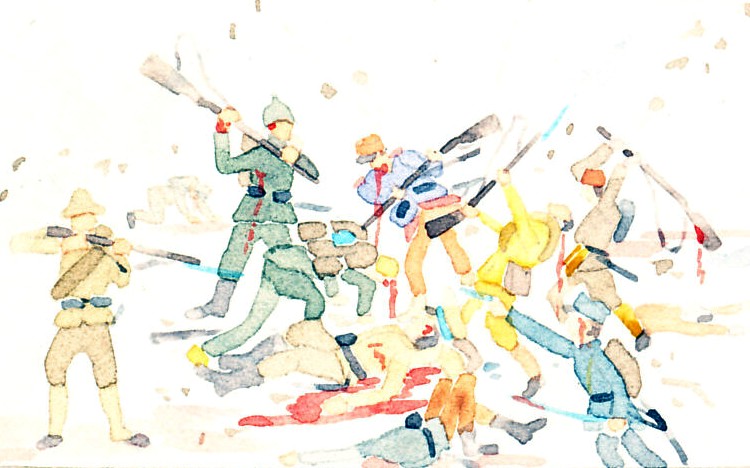
"The fighting in and about Sarikamish lasted in all nearly a fortnight, but the various and varying accounts of its later phases convey a somewhat blurred impression rather than provide a consecutive narrative. That impression is mainly of great masses of Turks, brave to the last but famished and half-frozen, being mown down by guns and maxims and rifle-fire on the main road, in the passes, and on the lower slopes of the mountains; or of their fierce attacks repulsed and Russian counter-attacks driven home, the cold steel finishing what was left undone by shell and bullet — the whole against a background of snow, in an atmosphere so arctic that the wounded succumbed to the cold where they fell."
A grim summary by Robert Machray of the Turkish offensive that ended in disaster in the mountains, snow, and bitter weather of the Caucasus in the Battle of Sarikamish. The incompetent War Minister Enver Pasha aimed to seize the frontier rail terminus at Sarikamish before advancing on Russia's fortress at Kars. He instead destroyed a Turkish Army, and left as many as 70,000 of him men dead.
The Great Events of the Great War in Seven Volumes by Charles F. Horne, Vol. III, 1915, pp. 46, 47, copyright © 1920 by The National Alumnia, publisher: The National Alumni, publication date: 1920
1915-01-18, 1915, January, Battle of Sarikamish, Turkey