Map of northeastern Italy, the border with Austria-Hungary, and the northern Adriatic. Red lines mark railroads and red dots forts.
Südl. Kriegsschauplatz, 1. Italienisch-Österr.-Ungarn GrenzgebietSouthern theater of operations. 1. Italian-Austrian-Hungarian border areaReverse:Postkarte des südlichen (Ital.-Österr.-Ungar.) Kriegsschauplatzes Nr. 1. Import.Logo LB
"Imperial-and-Royal orders and officials were soon ignored in Agram, Budapest, Laibach, Prague, Warsaw, and even Vienna. On 21 October the Parliament of Lower Austria voted to create a new German-Austrian state. In Budapest Károly's 'Independent and '48er Party' demanded termination of the 1867 Compromise. Karl refused all calls from his military to deploy forces against the newly-emerging national states. On 23 October Croatian units rebelled in Fiume. Concurrently, other Croatian as well as Bosnian, Czech, Magyar, and Romanian formations left their posts in Venetia and headed home. The k.u.k. Army was in a state of open revolt and informal dissolution.General Diaz finally launched his long awaited assault on 24 October 1918, the first anniversary of the start of the Battle of Caporetto. The Italian Fourth and Twelfth armies attacked in the direction of Monte Grappa north of Bassano, while the Eighth and Tenth armies crossed the middle Piave toward Vittorio Veneto. Surprisingly, Hapsburg forces fought tenaciously for 2 days — and then melted away."
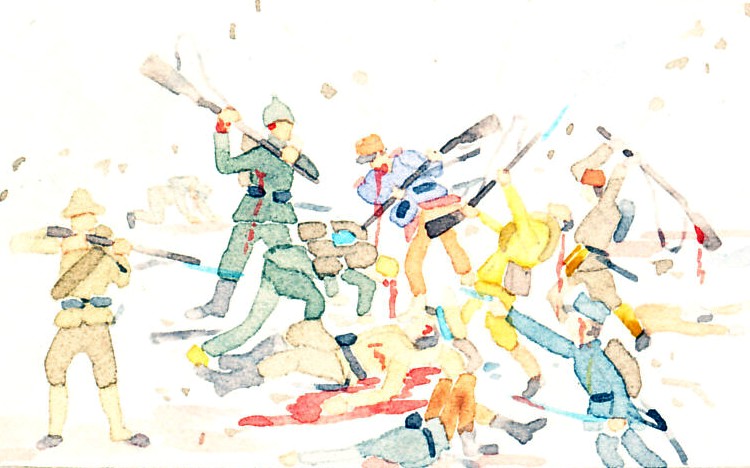
By October, 1918, Allied leaders had for months been pressing the Italians to launch an offensive against Austria-Hungary. With Bulgaria out of the war, Turkish forces being pushed out of Syria and Mesopotamia, the peoples of the Austro-Hungarian Empire forming nation states from the ruins of an Empire that still occupied northeastern Italy, General Armando Diaz and the Italian government feared having little clout to stake territorial claims at a post-war peace conference. Diaz's Battle of Vittorio Veneto, after a strong defense by the Austro-Hungarians, would turn into a advance into a broken, conquered nation. The 1917 Battle of Caporetto had been a major advance by the Austro-Hungarians and Germans that the Italians stopped on the Piave River. The Austro-Hungarian Army was kaiserlich-und-königlich, Imperial and Royal, as the Emperor was also Apostolic King of Hungary.
The First World War: Germany and Austria Hungary 1914-1918 by Holger H. Herwig, pp. 436–437, copyright © 1997 Holger H. Herwig, publisher: Arnold, publication date: 1997
1918-10-24, 1918, October, Battle of Vittorio Veneto, Vittorio Veneto, Battle of Caporetto