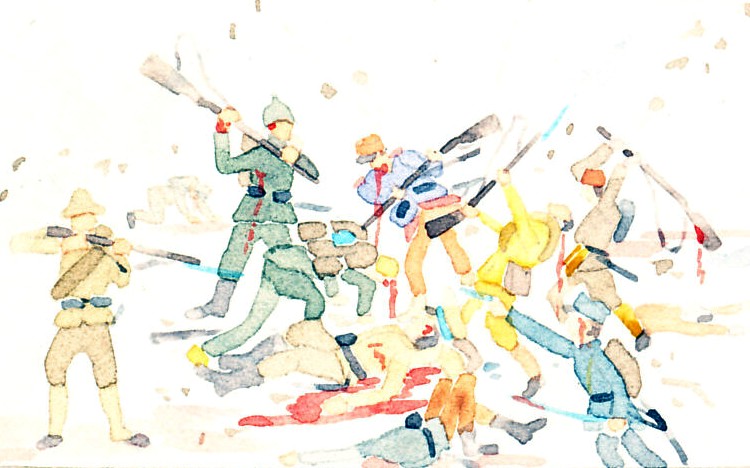
I've killed many Germans, but never women or children. Original French watercolor by John on blank field postcard. In the background are indolent Russian soldiers and Vladimir Lenin, in the foreground stands what may be a Romanian soldier who is telling the Russians, 'You call me savage. I killed a lot of Boches [Germans], but never women or children!'
T'appelles moi sauvage !. Moi, tuer Boches beaucoup, mais jamais li femmes et li s'enfants !You call me wild. I killed a lot of Boches [Germans], but never women or children!
"On February 16 [1918], at noon, Lenin and Trotsky sat in conference at Smolny with Karelin and another Left Social Revolutionary. A folded paper was brought to Lenin, and, without interrupting his remarks, he glanced at it. It was a telegram from General Samoilo, who had been left behind at Brest:General Hoffmann to-day gave official notice that the armistice concluded with the Russian Republic comes to an end on February 18 at 12 o'clock, and that war will be renewed on that day. He therefore invites me to leave Brest-Litovsk."
On February 10, 1918 Leon Trotsky, head of the Russian delegation to the Brest-Litovsk peace negotiations with the Central Powers, left the conference saying Russia would not sign a peace treaty, but would withdraw from the war, its peasant soldiers returning to their fields, its worker soldiers to their workshops. In the following days Trotsky and Vladimir Lenin debated whether the Germans would accept this situation or resume the war. On the 16th they received their answer from General Hoffmann, military head of the German delegation, to his Russian counterpart General Alexander Samoilo. The Smolny Institute had been the headquarters for the Petrograd Soviet of Soldiers and Workers Deputies from August, 1917, and was made Bolshevik headquarters after the October Revolution.
Brest-Litovsk: The Forgotten Peace; March 1918 by John W. Wheeler-Bennett by John W. Wheeler-Bennett, pp. 238–239, publisher: The Norton Library, publication date: 1971, first published 193
1918-02-16, 1918, February, Lenin, Vladimir Lenin, Trotsky, Leon Trotsky, Brest-Litovsk, armistice, Samoilo