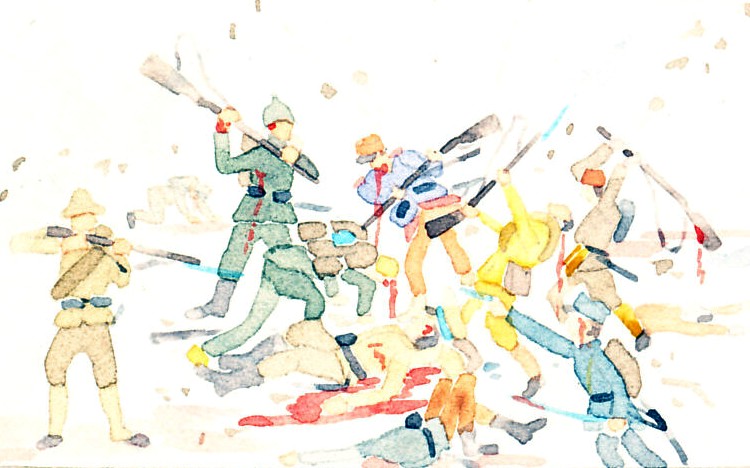
An angel drops a Christmas tree as she enters a room of fighting children. Those outfitted as an Austro-Hungarian, a German, and a Turk brandish their weapons over those representing Serbia, Great Britain, Russia, France, and Montenegro. A postcard by the Hungarian artist Mihali Biró.
SzerbOroszFranciaMontenegroSerbianRussianFrenchMontenegroReverse:Magyar Földrajzi Intézet Részvénytársaság, Budapest.Levelezö-LapThe Hungarian Geographical Institute Company, Budapest.Mailing-sheet
"It cannot be denied that [the defeat of Romania] was a brilliant success, but it altered very little the aspect of things in general, as the Chief Quartermaster General himself had to admit later: 'We had defeated the Rumanian army, but we were unable to destroy it. In spite of this victory, we came out weaker in the end, as far as the general conduct of the war was concerned.' However, the Central Empires wished to obtain some definite advantage from these events, and that is the reason why, on December 12th, trusting that President Wilson would come in as mediator, they announced that they would hold preliminary conferences with a view to negotiating peace."
French General Henri Pétain's explanation for Germany's peace initiative in December, 1916. Armies composed of units from all four Central Empires had participated in the rapid invasion and defeat of Romania, occupying the capital of Bucharest on December 6. United States President Woodrow Wilson had just been re-elected, in part on his campaign's claim that 'He kept us out of war,' something Wilson was finding increasingly difficult due to Germany's submarine warfare. Germany's Chief Quartermaster General was Erich Ludendorff. Pétain's account continues: 'Our answer was the new offensive at Verdun on December 15th [p. 207].'
Verdun by Henri Philippe Pétain, page 206, copyright © 1930, publisher: The Dial Press, publication date: 1930
1916-12-12, 1916, December, peace, peace proposal, Wilson, Woodrow Wilson, Romania, Mihaly Biro, Mihali Biro, Mihali Biró, Biró