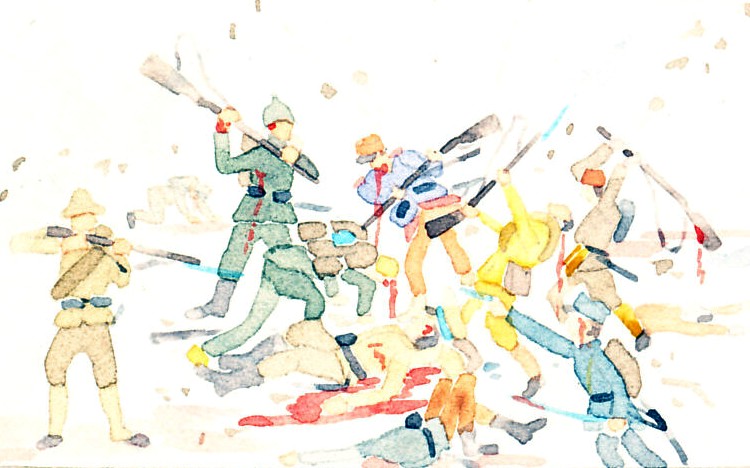
A folding postcard from a pencil sketch of an unsuccessful Allied gas attack in Flanders.
Erfolgloser feindlicher Gasangriff in FlandernUnsuccessful enemy gas attack in FlandersOutside:FeldpostkarteNachdruck verboten.Field postcardReproduction prohibited.
"August 1st [1917].The great brutal force of the initial blow has been parried. We survived the gruesome tension occasioned by the uncanny artillery fire, and we are able again to hold our heads high as the battle of living men is resumed. The struggle has now reached the phase of human effort, after unseen mechanical death has been knocking at the door day and night for weeks. The German fighting spirit was fully awakened, and heroes flung themselves from the islands of defense in the conquered district against the advancing masses and seriously weakened the flanks of the oncoming troops. Millions of shells have been spent, and now comes the test of strength and nerves."
Beginning of the report by Max Osborn, official German observer on the Flanders front, writing of the beginning of the Third Battle of Ypres, launched by the British and French on July 31, 1917. The preliminary bombardment had begun on July 15, and was more punishing than any yet laid down by British artillery. The infantry attack itself began before 4:00 a.m. on the 31st. Six hours later the creeping artillery, timed to keep ahead of the advancing British troops, had left the men well behind, the guns moving on to the second and third objectives as the infantry had largely failed to capture the first. By late afternoon a drizzle had turned to drenching rains that filled shell holes where men sheltered and turned the torn-up battlefield to muddy swamp.
The Great Events of the Great War in Seven Volumes by Charles F. Horne, Vol. V, 1917, p. 271, copyright © 1920 by The National Alumnia, publisher: The National Alumni, publication date: 1920
1917-08-01, 1917, August, Flanders, German machine gun squad, Battle of Passchendaele, Passchendaele, Third Ypres, Third Battle of Ypres