TimelineMapsSearch QuotationsSearch Images

Follow us through the World War I centennial and beyond at Follow wwitoday on Twitter


No. 1. L'Attaque Brusquée: d'après "le Bystander". The Sudden Attack, August 24, 1914. In French territory, with Luxemburg and much of Belgium behind him, a helmeted Kaiser Wilhelm knocks Joffre back with a powerful uppercut. The western end of the Allied line was held by the British. Their retreat from Mons, Belgium on August 24 brought the full length of the Allied line into France.
From L'Attaque & la Riposte — Originale présentation des phases de la Guerre (The Attack & the Retort — Original Presentation of the Phases of the War)
Ehrmann, Édition Lorraine, a set of six postcards and envelope.
Over maps of the French theater of operations on the western front in 1914 — Luxemburg, Belgium, northern France — cartoon figures of the French and German armies struggle. General Joffre represents the forces he commands. The German's upward-pointing mustache indicates Kaiser Wilhelm.
The titles of the cards appear only on the envelope.
1re Série
On the reverse of each card: Carte Postale
Tous les Pays étrangers n'acceptent pas la Correspondance au recto. (Se renseigner a la Poste).
Edition Lorraine
No. 1. L'Attaque Brusquée: d'après "le Bystander". The Sudden Attack, August 24, 1914. In French territory, with Luxemburg and much of Belgium behind him, a helmeted Kaiser Wilhelm knocks Joffre back with a powerful uppercut. The western end of the Allied line was held by the British. Their retreat from Mons, Belgium on August 24 brought the full length of the Allied line into France.
From L'Attaque & la Riposte — Originale présentation des phases de la Guerre (The Attack & the Retort — Original Presentation of the Phases of the War)
Ehrmann, Édition Lorraine, a set of six postcards and envelope.
Over maps of the French theater of operations on the western front in 1914 — Luxemburg, Belgium, northern France — cartoon figures of the French and German armies struggle. General Joffre represents the forces he commands. His adversary's upward-pointing mustache indicates Kaiser Wilhelm.
The titles of the cards appear only on the envelope.
1re Série
On the reverse of each card: Carte Postale
Tous les Pays étrangers n'acceptent pas la Correspondance au recto. (Se renseigner a la Poste).
Edition Lorraine

Image text

24 Aout d'après "le Bystander" (August 24, after "The Bystander")

[No. 1. L'Attaque Brusquée: d'après "le Bystander". The Sudden Attack, August 24, 1914.

1re Série]

On the reverse of each card: Carte Postale

Tous les Pays étrangers n'acceptent pas la Correspondance au recto. (Se renseigner a la Poste).

Edition Lorraine

Other views: Larger
Tuesday, August 25, 1914

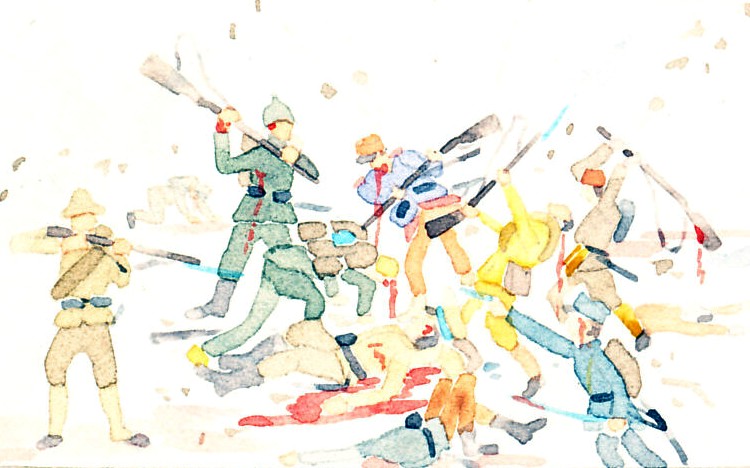
"On the morning of the 25th we beat a retreat, and I realized that the hope expressed in the lines I have just quoted was misplaced. This immensely bitter disappointment, the stifling heat, the difficulties of marching along a road encumbered by artillery and convoys, and finally, the dysentery with which I was stricken the night before make the 25th of August live in my memory as one of the most painful days I have known."

Quotation Context

An excerpt from the war memoirs of the great French historian Marc Bloch. His regiment took part in the Lorraine Offensive, advancing towards Belgium, then turning from it. By August 23 many wounded were on the roads, and word was there had been 'a great battle and, I believe, a great victory.' Bloch's bitter disappointment lay in learning that the victory was on the German side as his regiment joined the general retreat of the Entente Allies.

Source

Memoirs of War 1914-15 by Marc Bloch, page 81, copyright © Cambridge University Press 1988, publisher: Cambridge University Press, publication date: 1988

Tags

August, 1914, 1914-08-25, Allied retreat, Bloch