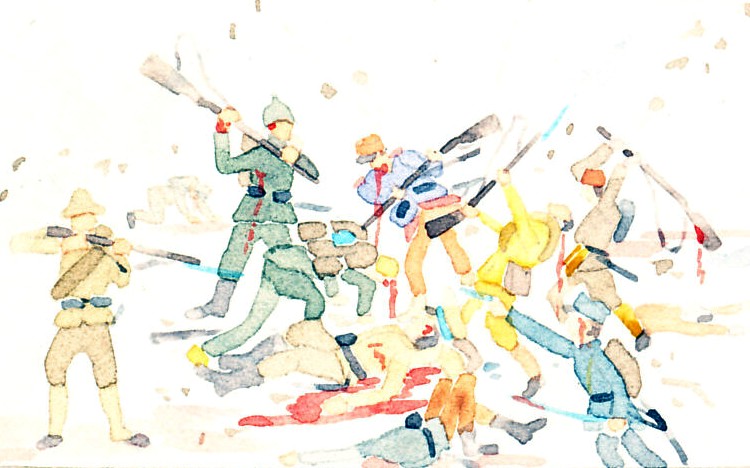
A Russian artillery crew at work. More than its adversaries, Russia suffered from munitions shortages. A card from Der Weltkrieg 1914-1918, a 1930s German history of the war illustrated (or not) with pasted-in cigarette cards.
Russische Artillerie. Die russische Artillerie war vortrefflich ausgerüstet. Es fehlte ihr aber, namentlich später, sehr häusig an Munition. Das erbeutete russische Geschützmaterial wurde von uns schnellmöglichst wieder verwertet, vor allem durch Umbau zu Flugabwehrkanonen. Übrigens verwendeten wir auch in großer Zahl russische Gewehre.Russian artillery. The Russian artillery was admirably equipped. It frequently lacked ammunition, however, especially later. We recycled captured Russian artillery material as quickly as possible, mainly by conversion to anti-aircraft guns. Incidentally, we also used large numbers of Russian guns.
"On the 5th and 6th of June [1916], Brusiloff's offensive really began to develop in the most remarkable manner. On his extreme left flank his troops forced the Austrians to retire for three miles from their first lines of trenches near Okna on the former day, and gave General Lechitsky his opportunity in Bukovina. Also on that day and on the next, the Russian's, on Brusiloff's right wing, having crumpled up the enemy's strongly fortified positions around Olyka, marched on rapidly towards Lutsk (Luck), and energetically beating down all opposition threw the Austro-Germans into such a panic that, abandoning their guns, they surrendered in thousands, whole regiments laying down their arms."
Excerpt from an account by Robert Machray of Russian General Alexsei Brusilov's great offensive of 1916. Brusilov had planned well. Although the Russians had only a slight numerical advantage over the Austro-Hungarians, they had dug jumping-off points close to the enemy trenches, had concealed reserves in new dugouts, had opened the offensive with a short bombardment, and attacked at four points along a broad, 20-mile front. Since 1914, German troops had reinforced their Austro-Hungarian ally, and would continue to do so for the remainder of the war. General Lechitsky commanded the Russian IX Army in Bukovina, Austria-Hungary, a region on the Russian border northeast of the Carpathian Mountains.
The Great Events of the Great War in Seven Volumes by Charles F. Horne, Vol. IV, 1916, pp. 190-191, copyright © 1920 by The National Alumnia, publisher: The National Alumni, publication date: 1920
1916-06-06, 1916, June, Brusilov, Brusilov Offensive, Bukovina, Russian artillery, Russian Artillery