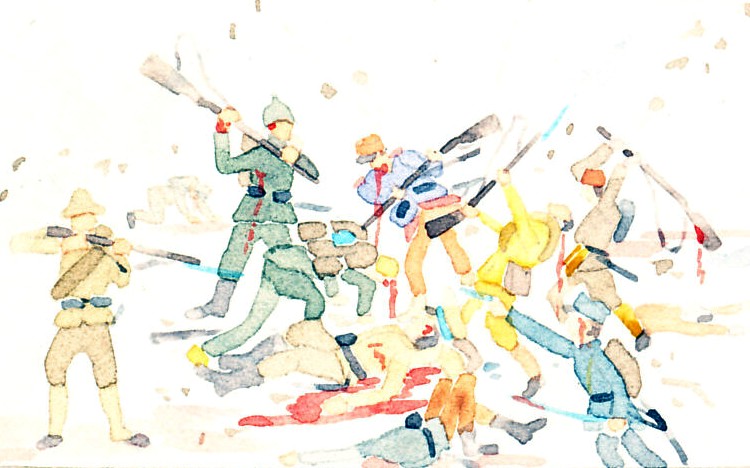
French sappers (mining engineers) discover and invade a German mine tunnel. A grim illustration of the battle underground. The sappers tunneling to lay mines beneath enemy positions could sometimes hear each other or come upon opposing tunnels.
1914-15 . . . La Guerre de Mines. Sape Allemange découvert et envahie par nos sapeurs.1914-15 . . . The Mine War. German sap discovered and invaded by our sappers.Logo: ELDReverse:Imp. E. Le Deloy, Paris.
"The real struggle began on April 7th. Listeners in a tunnel known as C4 announced that the Germans were mining towards them at speed. Mulqueen ordered a camouflet to be blown at once. It was the start of a frenzied contest that lasted for six weeks almost without a break and left indelible memories. Looking back on it in later life, Mulqueen described the period as one full of 'rude shocks. . . . Our men were buried and our nights made sleepless. We were striving to rectify a situation that threatened to overwhelm us.'"
A camouflet is an underground chamber created by an explosion. Unlike a mining operation designed to affect the surface — creating a crater or collapsing part of a fortress — a camouflet charge was intended to disrupt enemy mining operations. Frederick Mulqueen was commander of 182 Tunnelling Company which had recently moved into the Vimy Ridge sector when the British extended their line to free French forces for the Battle of Verdun. The English and Germans were both building on an existing network of mines in the area.
War Underground by Alexander Barrie by Alexander Barrie, pp. 162, 163, copyright © 1961 by Alexander Barrie, publisher: Ballantine Books, publication date: 1961
1916-04-07, 1916, April, mine, mining, countermining, camouflet