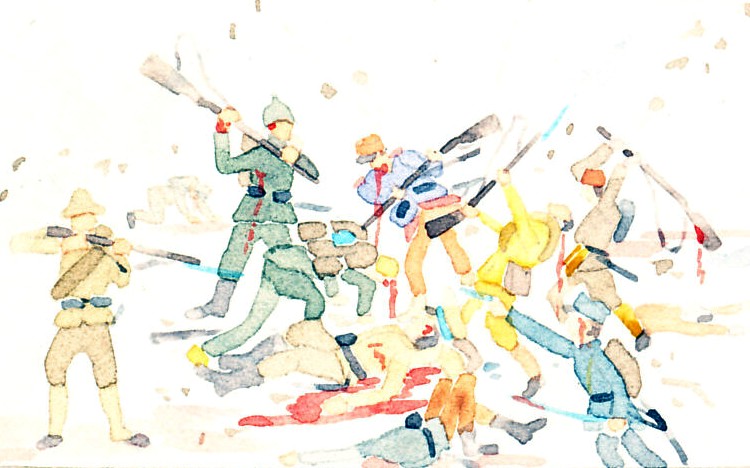
Imperial Russian field artillery in combat training in the snow at Camp B.K.
Reverse:Russian artillery on combat training at camp B.K. (Translation courtesy Thomas Faust, eBay's Urfaust.
"HeidekampfSonne Halde stampfen keuche BangeSonne Halde glimmet stumpfe WutSonne Halde sprenkeln irre StahleSonne Halde flirret faches BlutBlutUndBlutenBlutUndBluten BlutenDumpfen tropftUndDumpfenSiegt und krustetSonne Halde flackt und fleckt und flackertSonne Halde blumet knosper Tod.— August StrammHeath CombatSunshine hillside stamping panting fearSunshine hillside glimmers stumping rageSunshine hillside sprinkling crazy steelSunshine hillside flitting fanning bloodBloodAndBleedingBloodAndBleeding bleedingDudding dropsAndDuddingWins and CrustersSunshine hillside flares and flakes and flickersSunshine hillside budding bloomy death.— Translated by Jeremy Adler"
'Heidekampf' ('Heath Combat') by the German poet and playwright August Stramm, killed in action on the Dnepr-Bug Canal on the Russian front on September 1, 1915. A captain in the reserve, Stramm was called up in 1914, and served in the Vosges Mountains on the Western Front. In January 1915 he was made Commander of 9 Company II Battalion, 272dn Infantry Reserve Regiment, 41st Reserve Corps. The Corps was moved to the Eastern Front in April prior to the German-Austro-Hungarian Gorlice Tarnow Offensive. Although the offensive broke the Russian line, and the Russian Army retreated, ultimately along the entire front, it was not routed, but regularly entrenched and fought before resuming the retreat. Before the war, Stamm held a high position in the postal service, but began writing in earnest in 1912, and was first published in the avant-garde periodical Der Sturm in 1914. 'Heidekampf' is from his his collection of poems, Tropfblut: Gedichte aus dem Krieg — Blood Drop: Poems from the War.
The Lost Voices of World War I, An International Anthology of Writers, Poets and Playwrights by Tim Cross, page 142, copyright © 1989 by The University of Iowa, publisher: University of Iowa Press, publication date: 1989
1915-09-01, 1915, August, Stramm, August Stramm, poem, Heath Combat, Haidekampf, artillery, Russian field artillery