Zweibund — the Dual Alliance — Germany and Austria-Hungary united, were the core of the Central Powers, and here join hands. The bars of Germany's flag border the top left, and those of the Habsburg Austrian Empire and ruling house the bottom right.
Schulter an SchulterUntrennbar vereintin Freud und in Leid!'Shoulder to shoulderInseparably united in joy and in sorrow!
"In the stalemate of Quinn's we knew there was no way forward, that we had to break out of the trap in another direction, through fresh country. That was how the assault on Chunuk Bair, the most tragic event in the entire campaign, came about. It was planned of course, in conjunction with the landing of a division of British troops in Suvla Bay. The intention was to cut the Gallipoli peninsula in two, right across to the Narrows. But we knew perfectly well that Chunuk Bair was the key — the key, that is, to victory or defeat on the peninsula. That hill was vital. It dominated the middle of the peninsula and commanded ground right down to the Narrows. And in the August offensive Chunuk Bair was the objective of the New Zealand Infantry Brigade. Victory or defeat was in our hands."
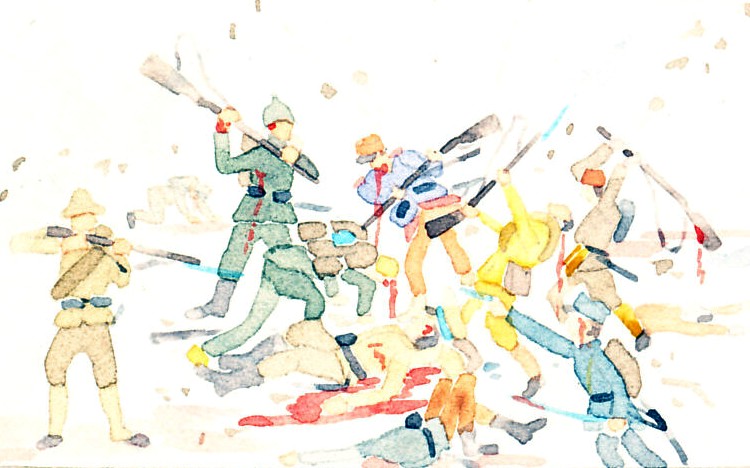
Excerpt from Maurice Shadbolt's 1980's interview with Dan Curham, a soldier of New Zealand's Wellington Battalion, tasked with taking the hill of Chunuk Bair on August 8, 1915. Between August 4 and 6, men had been landed furtively each night so the Turks would have no advance notice of a new offensive. By the 6th 25,000 men had joined those already holding the position at Anzac Cove. Further north, the British would open a new front at Suvla Bay, advancing quickly to join the ANZACs and cut across the Gallipoli Peninsula, isolating the Turkish defenders and finally breaking the stalemate the Gallipoli campaign had become. As with so many other efforts at Gallipoli, and in the war itself, nothing but more death and ruin came of it. Expecting the worst at a virtually undefended Suvla Bay, the commanders and men did little for two days. By the time they were ordered to advance, the Turks had bolstered their defenses. At Anzac, the Turks held their positions against the strengthened attackers who had struck at Quinn's Post. On August 8, the New Zealanders were ordered to take the high point of Chunuk Bair. Some who made the summit saw the Narrows of the Dardanelles, the gateway to Constantinople. Most of the men never left the hill.
Voices of Gallipoli by Maurice Shadbolt, page 45, copyright © 1988 Maurice Shadbolt, publisher: Hodder and Stoughton, publication date: 1988
1915-08-08, 1915, August, Chunuk Bair, New Zealand, Gallipoli