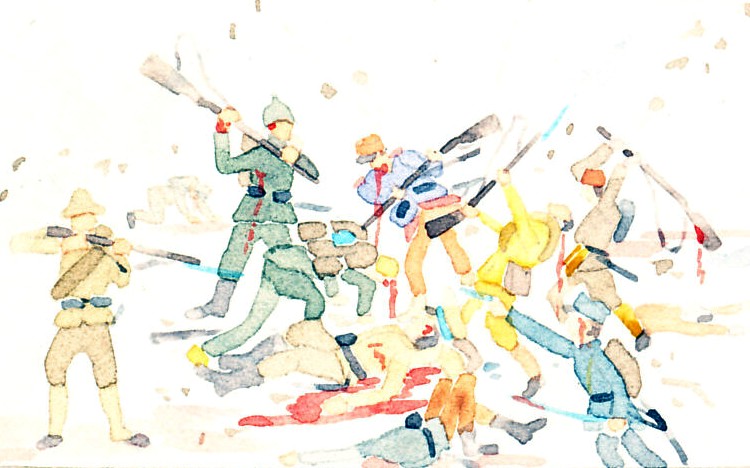
I've killed many Germans, but never women or children. Original French watercolor by John on blank field postcard. In the background are indolent Russian soldiers and Vladimir Lenin, in the foreground stands what may be a Romanian soldier who is telling the Russians, 'You call me savage. I killed a lot of Boches [Germans], but never women or children!'
T'appelles moi sauvage !. Moi, tuer Boches beaucoup, mais jamais li femmes et li s'enfants !You call me wild. I killed a lot of Boches [Germans], but never women or children!
"Suddenly the artillery fire died away. The front line became visible. But then we began firing again. Our artillery put the Russian trenches under heavy fire. I demanded that the reserves go in. We had a firing line, man against man. The Russians didn't advance and those who tried to retreat were blown away. We killed hundreds of them. It is irresponsible, how ruthlessly the Russians drive their men forward. My men were exemplary. An unshakeable wall. The night passed without incident. We left the Russians alone so that they could collect their wounded. Many were screaming all day in the wheatfield."
Ernst Nopper, a German officer on the border of Austria-Hungary and Polish Russia, writing on June 27, 1915. The Russians had attacked two days earlier, suffering heavy losses with no gain. The Gorlice-Tarnow Offensive, a joint German-Austro-Hungarian assault, had driven the Russians back, but not yet broken their line. The Russian version of the shell shortage was the most extreme of the major powers, the army lacking guns, artillery shells, rifles, and ammunition to respond to the German attacks.
Intimate Voices from the First World War by Svetlana Palmer and Sarah Wallis, page 105, copyright © 2003 by Svetlana Palmer and Sarah Wallis, publisher: Harper Collins Publishers, publication date: 2003
1915-06-27, 1915, June, Gorlice-Tarnow Offensive, Russian soldier, Russian Army