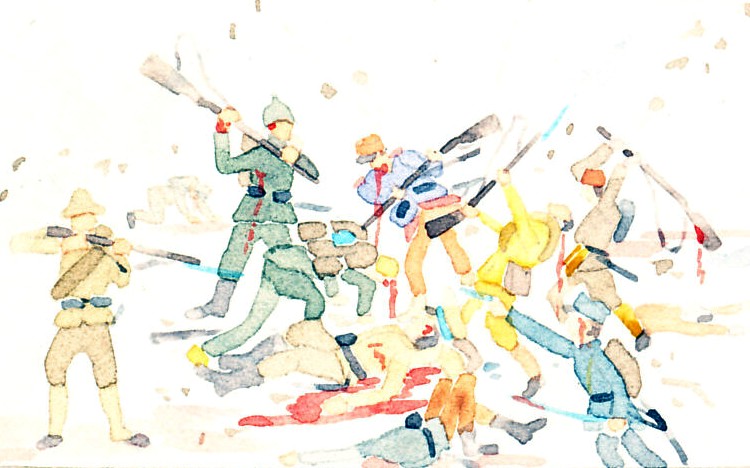
Russian troops fleeing a solitary German soldier. The Russian First Army invaded Germany in August 1914, and defeated the Germans in the Battle of Gumbinnen on the 20th. In September the Germans drove them out of Russia in the First Battle of the Masurian Lakes. In September and October, a joint German, Austro-Hungarian offensive drove the Russians back almost to Warsaw. Illustration by E. H. Nunes.
Die Russen haben große Hoffnungen auf den Krieg gesetzt, - es ist aber auch eine Kehrseite dabei.The Russians have set high hopes for the war - but there is also a downside to that.Reverse:Kriegs-Postkarte der Meggendorfer-Blätter, München. Nr. 25War postcard of the Meggendorfer Blätter, Munich. # 25
"History shows that Russia is never so strong as at the beginning of a war. We haven't that wonderful faculty for adaptation and improvisation which enables you French and English to make good all your omissions in peace in the very middle of a war. With us war only aggravates the evils of our political system because it sets our bureaucrats a task they are utterly incapable of performing. Would that I were mistaken! But I expect that things will go from bad to worse. Look what a tragic position we are in! We cannot make peace without dishonouring ourselves, and yet if we continue the war we are inevitably heading straight for a catastrophe!"
Russian General Stackelberg speaking to Maurice Paléologue, French Ambassador in Russia at a dinner at the French Embassy on Saturday, May 1, 1915. Before this statement, the general had said that Russia was headed for defeat and revolution because it could 'never beat the Germans.' The Ambassador responded that Russians were fighting splendidly, but lacked 'heavy artillery, aeroplanes, and munitions of war,' which it would have 'in a few months.' The General would prove to be right; the Ambassador wrong.
An Ambassador's Memoirs Vol. I by Maurice Paléologue, page 335, publisher: George H. Doran Company, publication date: 1925
1915-05-01, 1915, May, Russian Army, Russian soldier