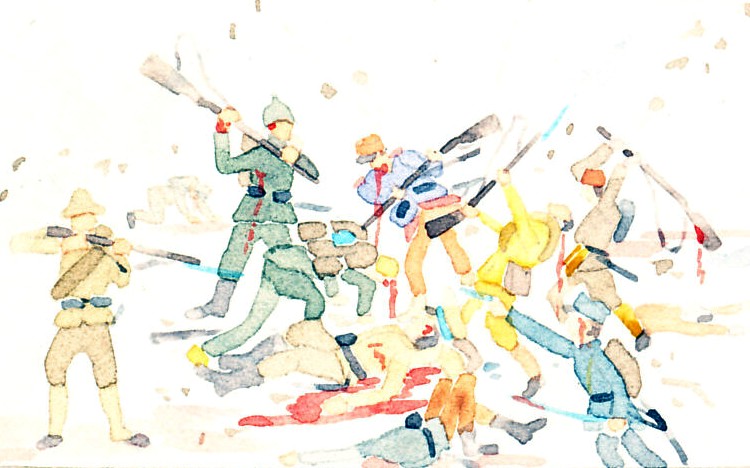
A folding postcard from a pencil sketch of an unsuccessful Allied gas attack in Flanders.
Erfolgloser feindlicher Gasangriff in FlandernUnsuccessful enemy gas attack in FlandersOutside:FeldpostkarteNachdruck verboten.Field postcardReproduction prohibited.
"It was a heavy, low cloud, as far as the eye could see; they described it variously as 'greyish-yellow' or 'greenish-yellow,' and also as 'two clouds . . . which appeared to merge into each other.' As the thing roiled toward them, the Canadians were baffled. . . . It was not long before the cloud reached the French lines to the north, which were joined to the Canadians' immediate left. As the dense cloud enveloped the French, nothing could be seen of them. Suddenly the Canadians heard the French fire begin to slacken, then stop altogether. Not long afterward, the French artillery also ceased to fire. Those Canadians nearest the French began to experience burning in their eyes, and coughing, and then the inability to breath; in effect strangling.Men in the reserve trenches in the rear were shocked to see thousands of the Algerian and African troops streaming past, eyes rolled up white, stumbling, staggering, falling, clutching their throats. Those few who could speak at all were gasping, 'gaz! gaz! gaz!' . . . As a Canadian artilleryman, Major Andrew McNaughton, described it: 'They literally were coughing their lungs out; glue was coming out of their mouths. It was a very disturbing, very disturbing sight.'"
Description of the war's first effective gas attack that launched the Second Battle of Ypres on April 22, 1915. The Germans had released chlorine gas from cylinders, having delayed their offensive for several days due to wind conditions. The Germans struck along a line held by French Colonial troops with the Canadians on their right. The Germans had first used poison gas in January in the Battle of Bolimow against the Russians, but the cold weather limited in its effectiveness. The Russians did not report its use to their Allies.
A Storm in Flanders: The Ypres Salient, 1914-1918: Tragedy and Triumph on the Western Front by Winston Groom, page 99
1915-04-22, 1915,April, Poison gas, poison gas, Ypres, Second Battle of Ypres