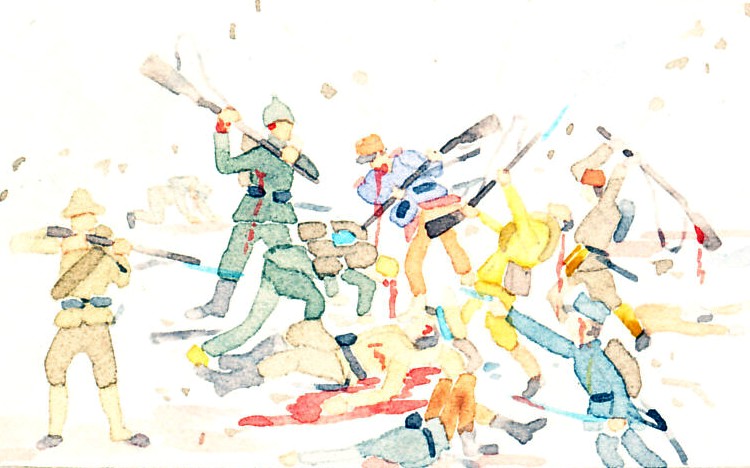
Orient's Erwachen — The East Awakens. The sun rises on a red fez, and the army of Turkey streams out, weapons at the ready. A beautiful design by Heinz Keune.
Orient's Erwachen — The East Awakenssigned: Heinz Keune
"The Tsar Nicholas has issued a proclamation to his people:Under German command the Turkish fleet has had the treacherous effrontery to attack our Black Sea coasts. We share with all the peoples of Russia the unshakable conviction that the rash intervention of Turkey will only hasten that country's downfall and open Russia's path towards the solution of the historic problem which our ancestors have bequeathed to us on the shores of the Black Sea."
Entry from the memoirs of Maurice Paléologue, French Ambassador to Russia, for Monday, November 2, 1914. On October 29 the Turkish destroyers Yavuz Sultan Selim and Midilli sank a Russian gunboat in the Black Sea port of Odessa in Crimea. The next day they shelled two more Russian ports. The ships had entered Turkish waters at the Dardanelles on August 8 as the German battleships Goeben and Breslau. Trying to draw Turkey into the war on the side of the Central Powers, Germany had turned the ships and their crews over to the Turkish Navy. In response to Paléologue's question about the meaning of the last phrase, Russian Foreign Minister Sergei Sazonov responded that, 'We must have tangible guarantees on the Bosphorus. As regards Constantinople, personally I don't want the Turks cleared out. I'd gladly leave them the old Byzantine city with a good-sized kitchen-garden all round. But no more!' As the historical center of the Eastern Orthodox Church, Constantinople held cultural and religious significance for Russia. As the gateway to the Straits leading from the Black Sea to the Mediterranean, the city was critical to Russia's commerce and war effort.
An Ambassador's Memoirs Vol. I by Maurice Paléologue, page 178, publisher: George H. Doran Company, publication date: 1925
1914, November, 1914-11-02, Goeben, Breslau