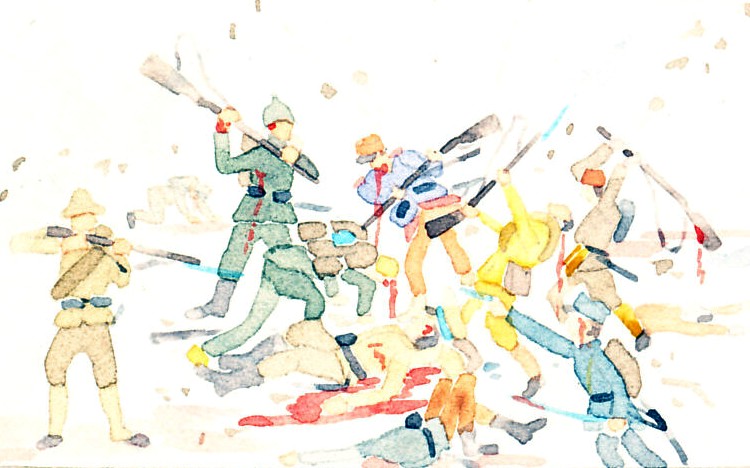
The soldier's life in the Hindenburg Trenches, postcard from a drawing by Kurzweg
Hindenburg-Grabenzum FriseurSpeise FettBitte klingelnSoldiers' Life in the Hindenburg trenchto the barbercooking fatplease ring the bell
"There was nothing left to capture in this region but the last strongholds of the Hindenburg Line. On October 5th, these were assaulted. The British Fourth Army, crossing the Scheldt between Crévecœur and Le Catelet, captured the plateau of Beaurevoir-Montbrèhain, and thereby completed for its sector of attack the conquest of the renowned German position. In contrast to this success, the French First Army, closely held to its mission of 'supporting at all costs the right of the British Army,' encountered the strongest sort of resistance east and northeast of Saint-Quentin."
Excerpt from the Memoirs of Allied Commander-in-Chief Ferdinand Foch on the continued breaking of Germany's Hindenburg Line, its last and strongest line of defense. Crèvecœur-sur-l'Escaut and Le Catelet are south of Cambrai and north of St. Quentin. The British Fourth Army was at the southern end, the right, of the British line.
The Memoirs of Marshal Foch, translated by Col. T. Bentley Mott by Ferdinand Foch, page 416, copyright © 1931 by Doubleday, Doran & Company, Inc., publisher: Doubleday, Doran & Co., publication date: 1931
1918-10-05, 1918, October, Hindenburg Line, St. Quentin, St.-Quentin