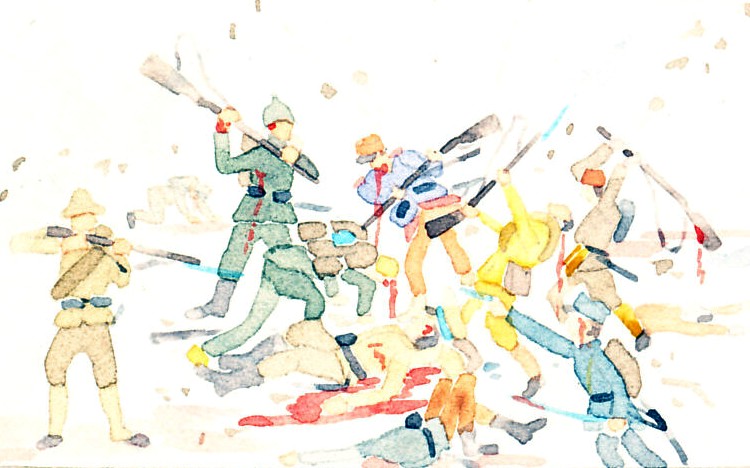
I've killed many Germans, but never women or children. Original French watercolor by John on blank field postcard. In the background are indolent Russian soldiers and Vladimir Lenin, in the foreground stands what may be a Romanian soldier who is telling the Russians, 'You call me savage. I killed a lot of Boches [Germans], but never women or children!'
T'appelles moi sauvage !. Moi, tuer Boches beaucoup, mais jamais li femmes et li s'enfants !You call me wild. I killed a lot of Boches [Germans], but never women or children!
"It was nearly 10 p.m. by the time Lenin emerged from the Mikhelson factory; sundown in Moscow at that time of year is around 9 p.m. and Fanny could not see in the dark. When Kaplan was arrested, she was not even wearing glasses. Not one of the eighteen witnesses who were interviewed actually saw her firing. And the bullet removed from Lenin's neck, almost four years later, was found not to have come from the Browning pistol alleged to have been held by Kaplan."
In 'Fanny Kaplan's Attempt to Kill Lenin', Martin Sixsmith contests the standard version of the attempted assassination of Vladimir Lenin. Kaplan, a Socialist Revolutionary, has been seriously injured in 1906 while building a bomb to kill the Governor of Kiev. She was nearly blinded in the incident, suffered injuries to her face and hands, and was condemned to life imprisonment. Like other political prisoners, she was freed after the 1917 February Revolution and returned to Moscow. In the election for the Constituent Assembly that was held after the Bolshevik Revolution, the Socialist Revolutionaries earned a majority of the seats, but Lenin had no intention of giving up power. Laying blame on Kaplan, and by extension her party, gave him an excuse and primary target for the Terror that followed the attempt on his life.
Was Revolution Inevitable? Turning Points of the Russian Revolution by Tony Brenton, page 184, copyright © Tony Brenton 2017, publisher: Oxford University Press, publication date: 2017
1918-08-30, 1918, August, Kaplan, Fanny Kaplan, Lenin, Vladimir Lenin, assassination