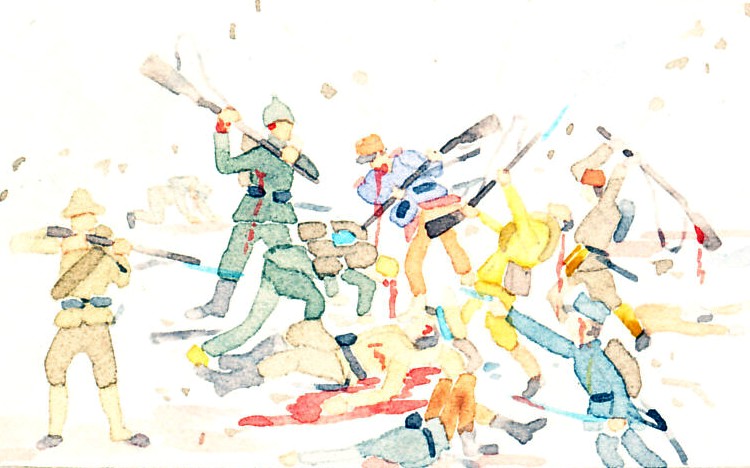
I've killed many Germans, but never women or children. Original French watercolor by John on blank field postcard. In the background are indolent Russian soldiers and Vladimir Lenin, in the foreground stands what may be a Romanian soldier who is telling the Russians, 'You call me savage. I killed a lot of Boches [Germans], but never women or children!'
T'appelles moi sauvage !. Moi, tuer Boches beaucoup, mais jamais li femmes et li s'enfants !You call me wild. I killed a lot of Boches [Germans], but never women or children!
"The Committee met again at 13 Bolotnaya Street in the Vyborg district on 16 October, this time with representatives from Moscow, and a Military Revolutionary Committee was formed. Once again the cautious Kamenev and Zinoviev demonstrated how unsure they were that Lenin's plans could work but again the vote went his way, with 4 members abstaining, 19 in favour and 2 against. All that remained now was the planning and the selection of the right moment.There was no doubt that the workers had rushed to the Bolshevik cause — the party had steadfastly refused to sully itself by any collaboration with Kerensky's government. When Lenin had arrived back in Petrograd in April the Bolsheviks, with a membership of just 10,000, could not have hoped to control anything, but following the failure of Kornilov's plans, the party's membership had soared to 300,000. At the time of the February revolution, there were 300 Soviets — by October there were 900."
The Bolshevik Central Committee met on October 29, 1917 (October 16 Old Style) to debate whether to seize power. Vyborg was a working-class district on the north side of the Russian capital of Petrograd. Alexander Kerensky had been in the government since the overthrow of Tsar Nicholas in the February Revolution, as Justice Minister, War Minister, and finally Prime Minister. He supported continuing the war, and had assumed near-dictitorial powers in defending the revolution against General Lavr Kornilov, a defense in which the government armed the Bolsheviks who would soon overthrow them. Soviets, councils of workers and soldiers representing cities, towns, military units, and factories, had been formed on the first day of the revolution following a pattern that dated to the revolution of 1905. Vladimir Lenin consistently supported ending the war, a position he sometimes held virtually alone.
1917: Russia's Year of Revolution by Roy Bainton, page 157, copyright © Roy Bainton 2005, publisher: Carroll and Graf Publishers, publication date: 2005
1917-10-29, October, 1917, Vyborg, Petrograd, Moscow, Lenin, Kerensky, Kamenev, Zinoviev, Kornilov, February Revolution, Tsar Nicholas, soviet, Vladimir Lenin