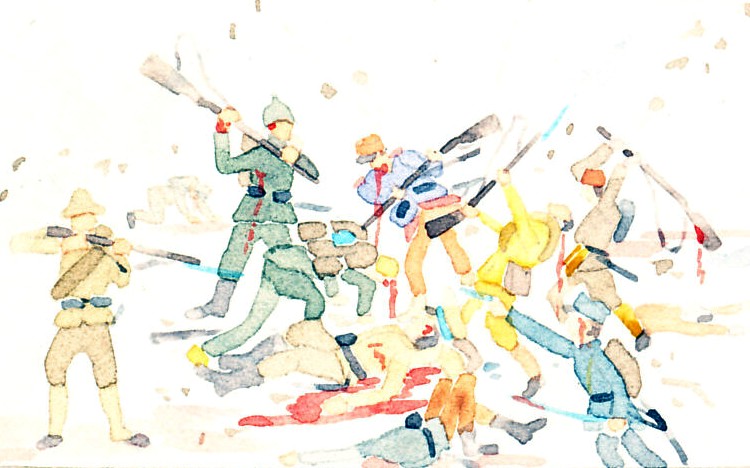
View across No Man's Land between Ypres and Messines in 1917 by Lance Corporal Hugh F. Ward, 97th Field Ambulance, Royal Army Medical Corps. Ward painted this while he was in the sector before, during, and after the June, 1917 Battle of Messines Ridge. Initialed 'H.W.'.
Initialed 'H.W.'.
"Each of the eleven firing teams had its own ecstatic story of success to tell as 933,200 pounds of the strongest known explosive erupted in the heart of Messines Ridge. All nineteen mines had fired in a drawn-out tumult of sound that carried hundreds of miles. Prime Minister Lloyd George heard it at home. So did Norton Griffiths, the man who had started the whole 'big idea' (with a thumbnail sketch that had angered the Engineer in Chief, twenty-five months before). And so did a student, Ormsby-Scott, lying awake in Dublin, 500 miles from the scene.Closely after the mines, the artillery opened fire with every gun that could be used and nine divisions of infantry, their heads surely singing with the noise, advanced through billowing smoke. The Battle of Messines had begun."
Messines Ridge had been captured by German troops from the British during the 1914 First Battle of Ypres. It was briefly taken by the French, but lost again in December of that year. John Norton Griffiths was a Conservative Member of Parliament who started the British tunneling (and mining) units. Germans, French, and British mined on the Western Front, setting off mines beneath enemy trenches and attacking what were usually dazed survivors. The 19 mines at Messines and Wystchaete were the largest of the war, and created craters as much as 430 feet across along a front of nine miles. British, Irish, Australian, and New Zealand troops took the ridges and what remained of Messines and Wystchaete, walking unopposed across the ruins. Ten thousand German soldiers were missing and 7,354 were taken prisoner.; as many as 20,000 may have died.
War Underground by Alexander Barrie by Alexander Barrie, page 235, copyright © 1961 by Alexander Barrie, publisher: Ballantine Books, publication date: 1961
1917-06-07, 1917, June, Messines Ridge, Battle of Messines, Battle of Messines Ridge