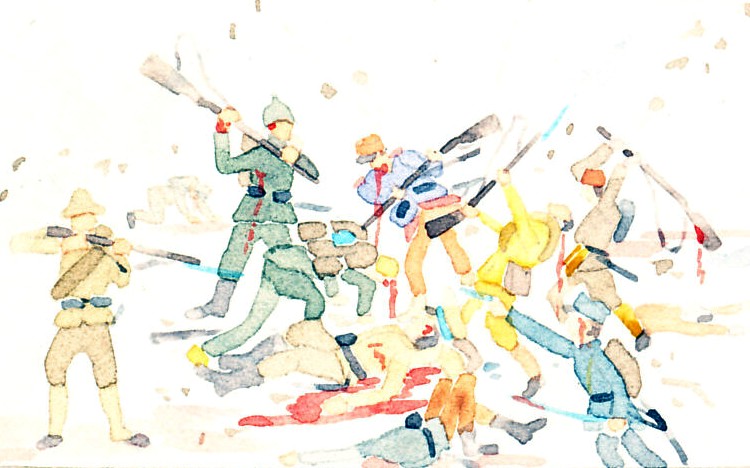
A French officer charging into battle in a watercolor by Fernand Rigouts. The original watercolor on deckle-edged watercolor paper is signed F. R. 1917, and addressed to Mademoiselle Henriette Dangon.
Signed F. R. 1917Reverse:Addressed to Mademoiselle Henriette Dangon
"They judged it prudent to separate the three battalions of the 296th Regiment from one another, and they billeted us fairly far apart. Our battalion was quartered in barracks four kilometers from Sainte-Menehould. It was only when we got there that we learned that the other battalions were elsewhere.The next day [May 31], at 7 p.m., they assembled us for departure to the trenches. Noisy demonstrations resulted: cries, songs, shouts, whistling; of course, the 'Internationale' was heard. I truly believe that, if the officers had made one provocative gesture, said one word against the uproar, they would have been massacred without pity, so great was the agitation."
Excerpt from the notebooks of French Infantry Corporal Louis Barthas of the 296th Regiment. After the failure of French commander in chief Robert Nivelle's 1917 spring offensive — the Second Battle of the Aisne, begun on April 16 — an offensive that Nivelle had asserted would provide the breakthrough of the German line that would lead to victory, mutinous incidents broke out in the French army, particularly among the troops that had suffered the highest rates of casualties in the offensive. The mutinies were of greater or lesser severity, beginning in April, with the most serious incidents in May and June. Some soldiers took the Russian Revolution as their model. Barthas was asked on May 30 to take the lead role in a soviet that would assume command of his company. He declined, but wrote a manifesto on behalf of the company protesting the delay in leaves after Nivelle's disaster. The 'Internationale' is a Socialist anthem from the late nineteenth century.
Poilu: The World War I Notebooks of Corporal Louis Barthas, Barrelmaker, 1914-1918 by Louis Barthas, page 328, copyright © 2014 by Yale University, publisher: Yale University Press, publication date: 2014
1917-05-31, 1917, May, French mutinies, mutiny