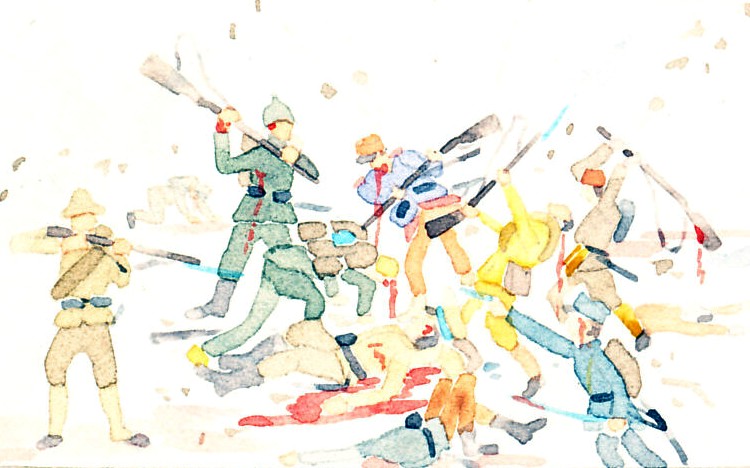
The 12th company advancing through shell fire to supply the 1st Battalion, 32nd Landwehr Infantry Regiment. A watercolor painting by Otto Oettel of the German 32nd Landwehr dated September 29, 1916.
signed: Oettel Sep 29 1916 - L32Reverse:12th company goes ahead through shell fire to supply the 1st battalion L32 [Translation courtesy Thomas Faust, ebay's Urfaust]
"In the course of the afternoon, the bombing swelled to such a pitch that all that was left was the feeling of a kind of oceanic roar, in which individual sounds were completely subordinated. From seven o'clock the square and the houses on it were subjected to fifteen-inch-shell bombardment at thirty-second intervals. There were many that did not go off, whose short, dull thumps shook the house to its foundations. Throughout, we sat in our basement, on silk-upholstered armchairs round a table, with our heads in our hands, counting the seconds between explosions. The witticisms dried up, and finally the boldest of us had nothing to say. At eight o'clock the house next door came down after taking two direct hits; its collapse occasioned a huge cloud of dust."
Sebastian Jünger on what he calls 'the legendary heart of the Somme,' the village of Guillemont, August 24, 1916 when the battle was in its eighth week. His platoon moved into Combles led by a runner wearing the first steel helmet the author had seen. The helmet, the runner's expressionless face, and monotonous voice signaled that Jünger's platoon was moving into a 'new and far harsher world.' They were still in reserve, and, after being given their own steel helmets, would take the front line the morning of the 25th.
Storm of Steel by Ernst Jünger, page 95, copyright © 1920, 1961, Translation © Michael Hoffman, 2003, publisher: Penguin Books, publication date: 2003
1916-08-24, 1916, August, steel helmet, Battle of the Somme, Somme