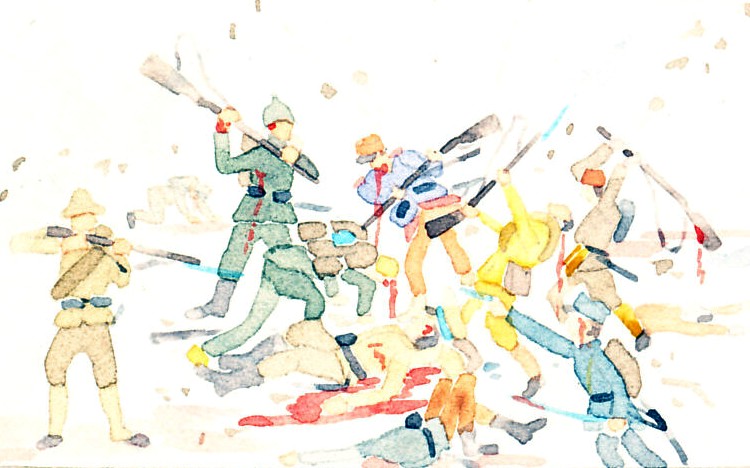
Postcard from a painting by W. Partke of a village in the Pripet Marshes in Russia dated February 14, 1916. An Hungarian officer wrote of the Marshes, 'almost half of the territory is covered by wet, impassable, and uncultivated forest, wooded territory, most of it useless, bushy, and impenetrable. The ground itself is divided into different kinds of marshy lands, impassable muddy districts, immense weedy and grassy territories, also regions covered by some kind of more solid grassy substance, and other thousands and thousands of acres of land perpetually under water.' The card is field postmarked on April 9, 1917 by Minenwerfer (trench mortar) Company 282.
Dorf in den PripetsümpfenW. Partke14.II.1916.Village in the Pripet MarshesW. PartkeFebruary 14, 1916
"Offensives against Kowel were mounted on 8th August and at more or less fortnightly intervals for the next three months. The Russian superiority, overall, was two-to-one at least: north of the Pripyat, 852,000 to 371,000 and south of it, 863,000 to 480,000. On the Kowel front, a great local superiority was built up: III Army, the Guard Army and VIII Army had, together, twenty-nine infantry and twelve cavalry divisions to twelve Austro-German infantry divisions. This, rather than the Romanian front, constituted Stavka's main effort. It was a complete failure."
One of the most successful campaigns of the war, Russia's Brusilov Offensive was launched on June 4, 1916 and overwhelmed the Austro-Hungarian front, but ground to a standstill by August with the addition of German troops and German commanders. The attacks against Kowel showed none of the innovation and surprise Alexsei Brusilov had demonstrated. Romania, long flirting with joining the Entente Allies, finally did so on August 27, too late to support Brusilov's advance. Stavka was the Russian High Command.
The Eastern Front, 1914-1917 by Norman Stone, page 271, copyright © 1975 Norman Stone, publisher: Charles Scribner's Sons, publication date: 1975
1916-08-08, 1916, August, Kowel, Brusilov Offensive