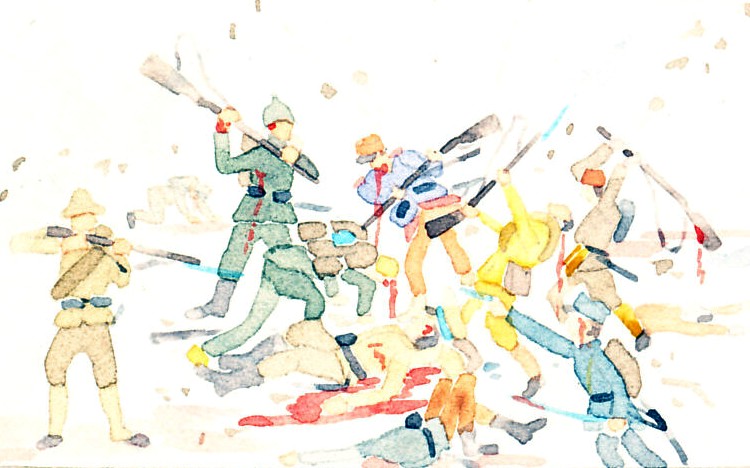
Original Austro-Hungarian sketch in colored pencil, dated December 20, 1915, field postmarked the next day. Signed 'Rob. Korschbu(?)'.
Dated 1915-12-20; signed 'Rob. Korschbu(?)'.
". . . it was rather difficult to improve the trench, especially as no work was possible by day owing to the fact that the Hun on Hill 70 would look down and shoot right along it. This fact was not fully appreciated by the Powers That Be who wear Red Hats, until one of them arrived about eleven o'clock in the morning on Christmas Eve and shouted down the steps of my dug-out for me. I went up and found an irate Staff Officer who wanted to know why the devil my men were not doing any work! I pointed out to him, respectfully but firmly, that unless he wanted half the men blotted out it was an impossibility. While arguing the point, he started along the trench and when he was about thirty yards away from the dug-out the Huns put over a covey of 'pip-squeaks'. I've never seen a staff officer hurry so fast in all my life! He bolted into my dug-out like a rabbit, head first. He then stayed so long talking about the impossibility of working by day, that I very nearly had to offer him lunch! Christmastime did not reduce the daily hate on both sides."
Lieutenant. G. Barber, 1st Battalion, Queen's Own Cameron Highlanders, 1st Brigade, 1st Division on an incident the morning of December 24, 1915 and why his men could not repair the trench they occupied. The pip-squeak was a small German artillery shell, named by British soldiers for the sounds it made in being fired and in flight.
1915, The Death of Innocence by Lyn Macdonald, pp. 591, 592, copyright © 1993 by Lyn Macdonald, publisher: Henry Holt and Company, publication date: 1993 (Great Britain); 199
1915-12-24, 1915, December, Christmas Eve