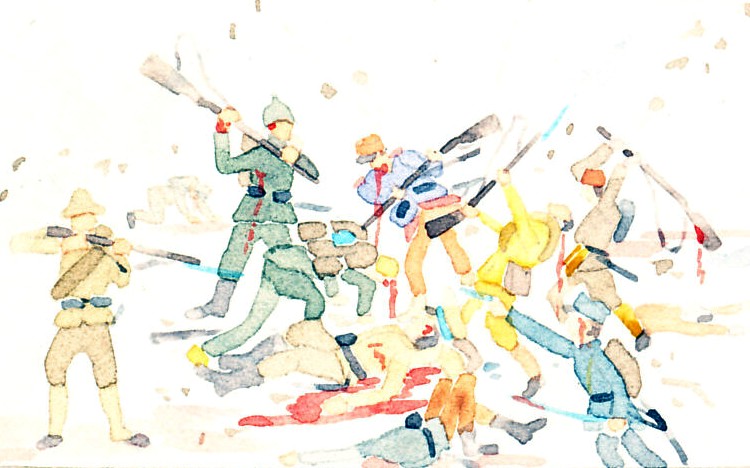
Russian troops fleeing a solitary German soldier. The Russian First Army invaded Germany in August 1914, and defeated the Germans in the Battle of Gumbinnen on the 20th. In September the Germans drove them out of Russia in the First Battle of the Masurian Lakes. In September and October, a joint German, Austro-Hungarian offensive drove the Russians back almost to Warsaw. Illustration by E. H. Nunes.
Die Russen haben große Hoffnungen auf den Krieg gesetzt, - es ist aber auch eine Kehrseite dabei.The Russians have set high hopes for the war - but there is also a downside to that.Reverse:Kriegs-Postkarte der Meggendorfer-Blätter, München. Nr. 25War postcard of the Meggendorfer Blätter, Munich. # 25
". . . By 17th July, the Germans had advanced perhaps five miles, but they had inflicted seventy percent losses on the defenders (including 24,000 prisoners, a quarter of the Russian numbers). This coincided with Mackensen's successes at Krásnik and Krasnostaw. Alexeyev pulled back his troops to the Narev, with corresponding withdrawals to left and right.. . . On 17th July, both Falkenhayn and Gallwitz—commanding the offensive—felt that they had planned things well enough. As the Germans came forward, they stumbled against increasing numbers of Russian troops, such that the 62 battalions and 188 guns that had faced the initial German attack rose to 100 and 600 respectively once the Germans arrived on the Narev. German attacks fared badly—the guns unprepared for Russian resistance, the troops defeated by machine-gunnery . . ."
The German-Austro-Hungarian Gorlice-Tarnow Offensive, now in its third month, continued. Still holding the city of Warsaw and some of its defensive fortresses, the Russians mounted a defense that temporarily held the invaders at bay. Stavka, the Russian High Command, did not think the line would hold, and soon, on July 22, ordered a resumption of the Russian retreat. Mackensen and Gallwitz were German generals, Falkenhayn the German Commander in Chief.
The Eastern Front, 1914-1917 by Norman Stone, page 180, copyright © 1975 Norman Stone, publisher: Charles Scribner's Sons, publication date: 1975
1915-07-17, 1915, July, retreat,