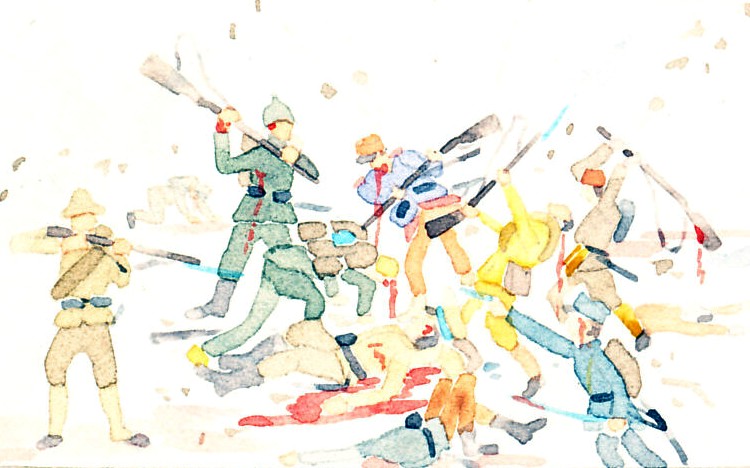
Russian troops fleeing a solitary German soldier. The Russian First Army invaded Germany in August 1914, and defeated the Germans in the Battle of Gumbinnen on the 20th. In September the Germans drove them out of Russia in the First Battle of the Masurian Lakes. In September and October, a joint German, Austro-Hungarian offensive drove the Russians back almost to Warsaw. Illustration by E. H. Nunes.
Die Russen haben große Hoffnungen auf den Krieg gesetzt, - es ist aber auch eine Kehrseite dabei.The Russians have set high hopes for the war - but there is also a downside to that.Reverse:Kriegs-Postkarte der Meggendorfer-Blätter, München. Nr. 25War postcard of the Meggendorfer Blätter, Munich. # 25
"Saturday, July 3, 1915.The imperial rescript which was published three days ago is causing great excitement. Everyone demands the immediate summoning of the Duma and some go so far as to claim that henceforward ministers shall be responsible to Parliament — a change which would mean nothing less than the end of autocracy.There is considerable unrest among the workmen. One of my informers, B———, has notified me of a recrudescence of socialist propaganda in the barracks, particularly in the Guards' barracks. The Pavlovsky and Volhynian regiments are said to be more or less contaminated."
Entry for July 3, 1915 from the memoirs of Maurice Paléologue, French Ambassador to Russia. On June 27, 1915, the Russian press published an Imperial declaration that closed with the announcement that the Russian Council of the Empire (upper house) and the Duma (lower house) would meet in the immediate future. Russia's seemingly endless retreat before the combined forces of Germany and Austria-Hungary and their Gorlice-Tarnow Offensive, its enormous losses, and the government's continued failure to resolve the shortages of artillery, shells, rifles, and ammunition, increasingly undermined what faith nobles, workers, soldiers, and peasants had in their autocratic Emperor, Nicholas II. The Duma had been founded after the Russian Revolution of 1905. With the onset of the war, the Fourth Duma had dissolved itself, but was reconstituted in August, 1915.
An Ambassador's Memoirs Vol. II by Maurice Paléologue, pp. 24, 25, publisher: George H. Doran Company
1915-07-03, 1915, July, Russian Army