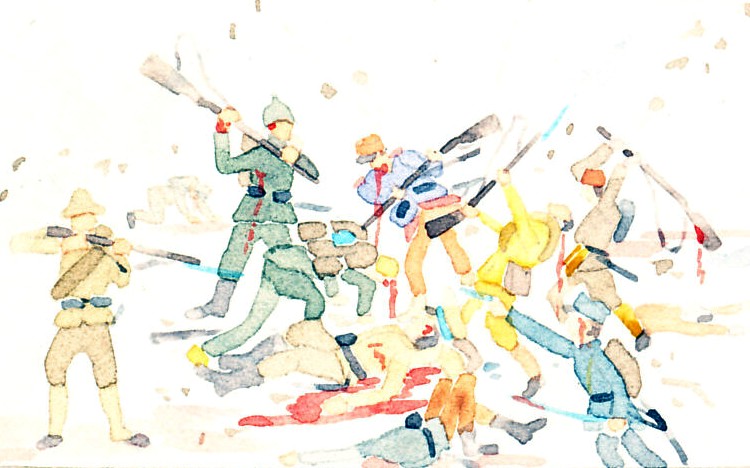
Children playing 'In the Dardanelles'. From February 19 to March 18, 1915, a Franco-British fleet tried to force its way through the Dardanelles to Constantinople. The Strait was defended by forts, some with modern German artillery. After a failure to break through on March 18, the Allies decided to invade, and in April, landed on the Gallipoli peninsula. Illustrated postcard by Pauli Ebner.
In den DardanellenP. Ebner.Reverse:Nr. 992M. Munk WienGeschützt
"Another collection has been announced at school, for copper, again, but also for tin, lead, zinc, brass and old iron to make gun-barrels, field guns, cartridge cases and so forth. There is a keen competition between the classes. Our class, the fourth, has so far collected the most. I turned the whole house over from top to bottom. Grandma cried, 'The wench will bankrupt me! Why don't you give them your lead soldiers instead of cleaning me out!' So my little army had to meet their deaths."
Entry for March 11, 1915 by Piete Kuhr, a then-twelve-year-old girl from Schneidemühl, East Prussia (now Pila, Poland). Eight months into the war, Schneidemühl had already been crowded with German refugees fleeing the initial advance of the Russians into East Prussia, Russian POWs taken at the Battle of Tannenberg, and German troops moving to the Eastern Front in increasing numbers. Airmen had died in training at the town's airfield. A POW camp had been set up. In November, Piete nearly died from the influenza epidemic which had run through the camp and struck the town. Shortly before her illness, she had stopped playing with dolls and begun playing with toy soldiers.
Intimate Voices from the First World War by Svetlana Palmer and Sarah Wallis, pp. 61, 62, copyright © 2003 by Svetlana Palmer and Sarah Wallis, publisher: Harper Collins Publishers, publication date: 2003
toy soldier, 1915, 1915-03-11, March, children, child, girl