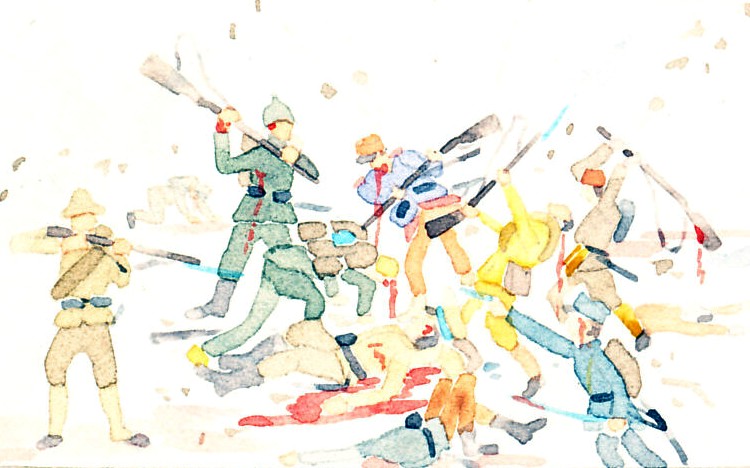
I've killed many Germans, but never women or children. Original French watercolor by John on blank field postcard. In the background are indolent Russian soldiers and Vladimir Lenin, in the foreground stands what may be a Romanian soldier who is telling the Russians, 'You call me savage. I killed a lot of Boches [Germans], but never women or children!'
T'appelles moi sauvage !. Moi, tuer Boches beaucoup, mais jamais li femmes et li s'enfants !You call me wild. I killed a lot of Boches [Germans], but never women or children!
"The scene of battle now shifts to the frozen North, where the Russians are courting fresh disaster in the treacherous region of the Mazurian Lakes in East Prussia. Early in February, a small Russian Army in command of Gen. Sievers had rashly invaded East Prussia from the North. As usual, the Germans proceeded to envelop and trap this army.. . . On February 10th, the snow still falling heavily, the Russians made a stand at Eydtkuhnen. At midnight the Germans launched a surprise attack and drove the Russians from village to village, until on February 15th, this wing was forced back across the Russian frontier."
The German Eighth Army attacked the Russian invaders of East Prussia from the west on February 7, 1915 in a blinding snowstorm. The new German Tenth Army attacked from the north the next day. Unaware of the second German army, the Russians were threatened with encirclement in the Second Battle of the Masurian Lakes.
King's Complete History of the World War by W.C. King, page 147, copyright © 1922, by W.C. King, publisher: The History Associates, publication date: 1922
1915-02-10, 1915, February, Russian soldier, winter