Postcard of Kaiser Wilhelm II and Kaiser Franz Joseph, in the Secessionist style. Kaiser Wilhelm is wearing the uniform and shako of the Death's Head Hussars.
Völkerkrieg (people's war)1914; In Treue FestPeople's WarFirm in Loyalty
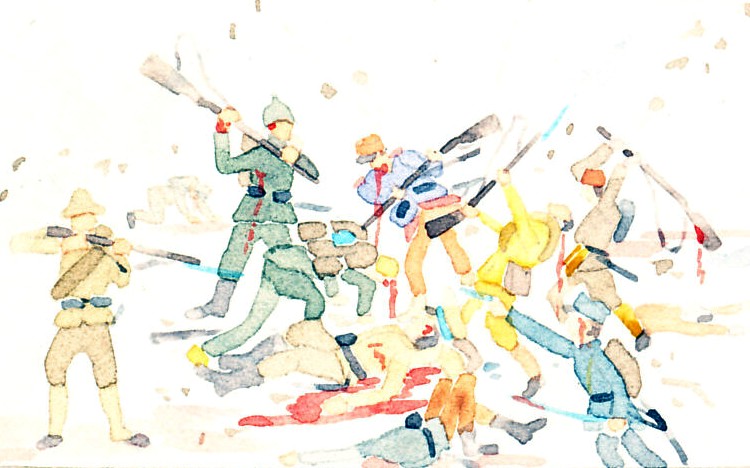
". . . [Serbian] King [Peter] Karageorgevic mounted the heights of Rudnik to inspire the army, and [Field Marshall] Putnik began a vast counterattack with two hundred thousand troops on December 2[, 1914]. The three divisions of the Serbian First Army converged with the three divisions of the Serbian Third Army on Valjevo, hammering the Austrian Sixth Army and the Fifth Army's XIII Corps out of Razana and Valjevo. The four divisions of the Serbian Second Army closed from Obrenovac on the right and Lazarevac on the left around the Fifth Army's VIII Corps. Putnik had finally been resupplied with shells and bullets and had brought up all of the reserves that were left in the kingdom . . ."
Under the command of Field Marshall Putnik, the Serbian army had been retreating before Austria's third, and final, 1914 invasion of Serbia. Austro-Hungarian commander Oskar Potiorek had inadequately supplied his men, then driven them for weeks through the mountains, snow, and mud of northwest Serbia. Many of his men had abandoned their weapons along the way, and his army had overstretched their supply lines. He had further weakened his attack in a costly attempt to take the Serbian capital of Belgrade. Putnik had retreated to a position close to his supplies, and concentrated his army for an all-out counterattack. Exhausted, underfed, ill-clothed, and ill-equipped, the Austro-Hungarian invaders collapsed.
A Mad Catastrophe by Geoffrey Wawro, page 328, copyright © 2014 by Geoffrey Wawro, publisher: Basic Books
1914-12-02, December, 1914, Serbia, Putnik, King Peter