TimelineMapsSearch QuotationsSearch Images

Follow us through the World War I centennial and beyond at Follow wwitoday on Twitter

Three headstones at the Necropole Craonelle, a French military cemetery, of British soldiers who died May 27, 1918, most likely killed in the German Aisne offensive that began that day. From left to right the headstones are those of Norman Gibson, East Yorkshire Regiment, age 18; C. G. Sills, Machine Gun Corps; and G. Rees, Yorkshire Regiment. Webmatters.net includes these men and two others noting that, 'These men were caught up the whirlwind of Operation Blücher launched by the Germans on the morning of 27th May 1918. They were part of the 150th Brigade of 50th Division holding the Plateau de Californie and Craonne.'
Text:
41629 Private Norman Gibson, East Yorkshire Regiment, 27th May 1918, Age 18
67830 Private C. G. Sills, Machine Gun Corps (Inf.), 27th May 1918, Age 33
34962 Private G. Rees, Yorkshire Regiment, 27th May 1918

Three headstones at the Necropole Craonelle, a French military cemetery, of British soldiers who died May 27, 1918, most likely killed in the German Aisne offensive that began that day. From left to right the headstones are those of Norman Gibson, East Yorkshire Regiment, age 18; C. G. Sills, Machine Gun Corps; and G. Rees, Yorkshire Regiment. Webmatters.net includes these men and two others noting that, 'These men were caught up the whirlwind of Operation Blücher launched by the Germans on the morning of 27th May 1918. They were part of the 150th Brigade of 50th Division holding the Plateau de Californie and Craonne.' © 2013, John M. Shea

Image text

41629 Private Norman Gibson, East Yorkshire Regiment, 27th May 1918, Age 18

We miss him most

Who loved him best

2, Alexandra Road

Windemere. Eng.


67830 Private C. G. Sills, Machine Gun Corps (Inf.), 27th May 1918, Age 33

Abide with me


34962 Private G. Rees, Yorkshire Regiment, 27th May 1918

Other views: Larger
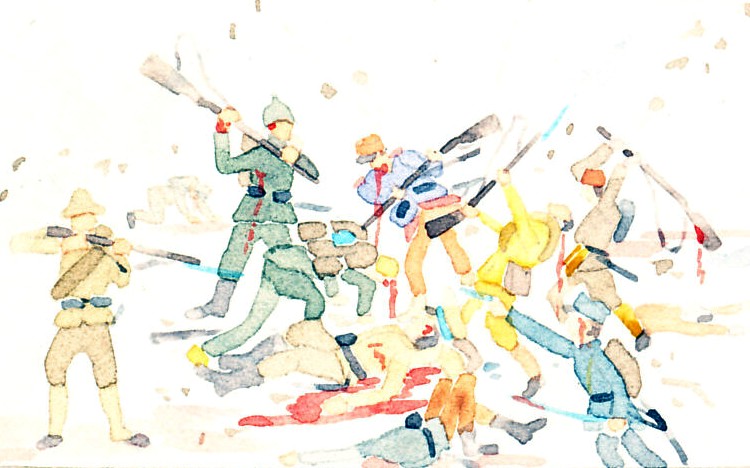
Monday, May 27, 1918

"It was difficult to get a clear picture of the attack. This had been so violent and our trenches so thinly held that all organised resistance on our divisional front had been at once overwhelmed. But the chief danger had come apparently from the flanking movements, helped as those were by the pronounced salient we were holding. The enemy had carried the strong French positions on the Chemin des Dames after a fierce but short assault, and at the same time under cover of the very heavy mist—the sure shield of the German offensives—and helped by the sparse nature of the trench garrison, had worked his way up the Miette stream on the right. Indeed, the advance on this flank was so rapid that small groups of Germans were across the Aisne near the Bois de Gernicourt before the remnants of the 23rd Brigade had been collected at Pontavert . . . it was evident that any attempt to hold the line of the river with the few survivors was quite unthinkable."

Quotation Context

Excerpt from Sidney Rogerson's The Last of the Ebb, an account of his experiences on May 27, 1918, the first day of the German Aisne Offensive. Four British divisions that had been devastated in Operations Michael and Georgette in March and April had been moved to the eastern end of the Chemin des Dames, in what was expected to be a quiet sector, one held by the French. French General Denis Auguste Duchêne ignored General Henri Philippe Pétain's order to strengthen and restructure his line and dismissed reports of German preparations for an offensive.

Source

The Last of the Ebb: the Battle of the Aisne, 1918 by Sidney Rogerson, pp. 39–40, copyright © Sidney Rogerson, 1937, publisher: Frontline Books, publication date: 2011

Tags

1918-05-27, 1918, May, Aisne Offensive, Norman Gibson, C. G. Sills, G. Rees, Gibson, Sills, Rees