TimelineMapsSearch QuotationsSearch Images

Follow us through the World War I centennial and beyond at Follow wwitoday on Twitter


An advertising card of the Rumanian Army from the series Armées des États Balcaniques, published in 1910.
The card shows, from left to right: a non-commissioned officer and artillery gunners, a staff officer, a rosiori (a red hussar), a mounted policeman (dismounted), a kalarachi (territorial reserve cavalry), a chasseur (venatori or rifleman), and an infantryman.

Reverse:
Roumanie
Le service militaire general est obligatoire pour les Roumains. Il commence avec la 21me année et dure 25 ans. Le service actif est théoriquement de 7 ans, mais se décompose en réalité en une période de service effectif de 3 à 5 ans et en une seconde période de 2 à 4 ans de congé.  L’armée roumaine se divise en quatre corps comprenant 3000 officiers, 48,000 hommes et 360 pièces d’artillerie. Sur pied de guerre, l’effectif pourrait être porté à 3500 officiers et 150,000 hommes auxquels il convient d’ajouter 50,000 miliciens et territoriaux. 
– Au recto de cette carte figurent, en commençant par la gauche : un sous-officier d’artillerie et des artilleurs, un officier d’état major, un hussard rouge (rosiori), un homme de la gendarmerie montée, un hussard kalarachi, un chasseur (venatori), et un fantassin.
Romania
General military service is compulsory for Romanians. It starts at age 21, and lasts 25 years. Active duty is theoretically seven years, but in reality is divided into a period of active service of 3 to 5 years and a second period of 2 to 4 years of leave. The Romanian army is divided into four army corps consisting of 3,000 officers, 48,000 men and 360 artillery pieces. On a war footing, the number could be increased to 3,500 officers and 150,000 men to which should be added 50.000 militia and territorials [home guard]. - The front of this card shows, starting from the left: a noncommissioned officer and artillery gunners, a staff officer, a rosiori [the Romanian equivalent of a hussar], a mounted police

An advertising card of the Romanian Army from the series Armées des États Balcaniques, published in 1910.
Shown, from left to right, a non-commissioned officer and artillery gunners, a staff officer, a rosiori (a red hussar), a mounted policeman (dismounted), a kalarachi (territorial reserve cavalry), a chasseur (venatori or rifleman), and an infantryman.

Image text

Véritable Extrait de Viande Liebig.

Voir L’Explication au verso.


Reverse:

Roumanie

Le service militaire general est obligatoire pour les Roumains. Il commence avec la 21me année et dure 25 ans. Le service actif est théoriquement de 7 ans, mais se décompose en réalité en une période de service effectif de 3 à 5 ans et en une seconde période de 2 à 4 ans de congé. L’armée roumaine se divise en quatre corps comprenant 3000 officiers, 48,000 hommes et 360 pièces d’artillerie. Sur pied de guerre, l’effectif pourrait être porté à 3500 officiers et 150,000 hommes auxquels il convient d’ajouter 50,000 miliciens et territoriaux. – Au recto de cette carte figurent, en commençant par la gauche : un sous-officier d’artillerie et des artilleurs, un officier d’état major, un hussard rouge (rosiori), un homme de la gendarmerie montée, un hussard kalarachi, un chasseur (venatori), et un fantassin.


Romania

General military service is compulsory for Romanians. It starts at age 21, and lasts 25 years. Active duty is theoretically seven years, but in reality is divided into a period of active service of 3 to 5 years and a second period of 2 to 4 years of leave. The Romanian army is divided into four army corps consisting of 3,000 officers, 48,000 men and 360 artillery pieces. On a war footing, the number could be increased to 3,500 officers and 150,000 men to which should be added 50.000 militia and territorials [home guard]. - The front of this card shows, starting from the left: a non-commissioned officer and artillery gunners, a staff officer, a rosiori [red hussar], a mounted policeman [dismounted], a kalarachi [territorial reserve cavalry], a chasseur (venatori) [rifleman], and an infantryman.


Armées des États Balcaniques. Roumanie.

Armies of the Balkan states. Romania.


Véritable Extrait de Viande Liebig.

Ne concourt plus dan les Expositions depuis 1885.

L’Extrait de Viande Liebig sert à preparer ou à améliorer toutes

Other views: Larger, Back
Saturday, September 1, 1917

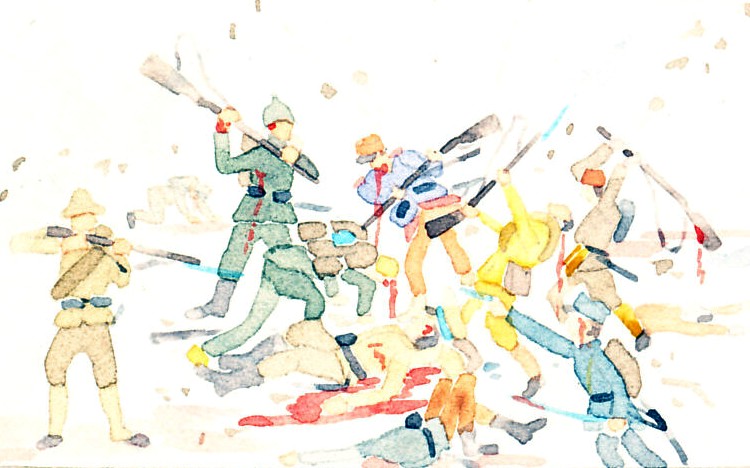
"Grigorescu's counteroffensive began on 1 September [1917]. The VIII Corps did hold its positions, but things did not go well for the Romanian attack group commanded by General Popescu. Artillery preparation was insufficient, and coordination with the infantry during the battle was poor. The Alpine Corps was entrenched in rough, wooded terrain, well supported by artillery, machine guns, and mortars. Its infantry resisted the Romanian assault step by step. From the perspective of the Alpine Corps, it was a repetition of the slaughter of the Russians two day before, only now it was Romanian soldiers who were being mowed down. The attack was suspended at noon but resumed in the evening. Only a quarter of the lost ground was reconquered. Continuation of the Romanian advance was postponed until 3 September in order to rest and reorganize the troops."

Quotation Context

On August 28, 1917, the German Alpine Corps attacked two Russian divisions holding the Romanian-Russian front at the village of Muncelu, driving the Russians back as much as four kilometers. Allied troops counterattacked on August 29 with the Russians suffering heavily in repeated and determined attacks. On September 1, the Romanians took the lead, with similar results.

Source

The Romanian Battlefront in World War I by Glenn E. Torrey, page 233, copyright © 2011 by the University Press of Kansas, publisher: University Press of Kansas, publication date: 2011

Tags

1917-09-01, 1917, September, Muncelu, Battle of Muncelu, Romanian Army