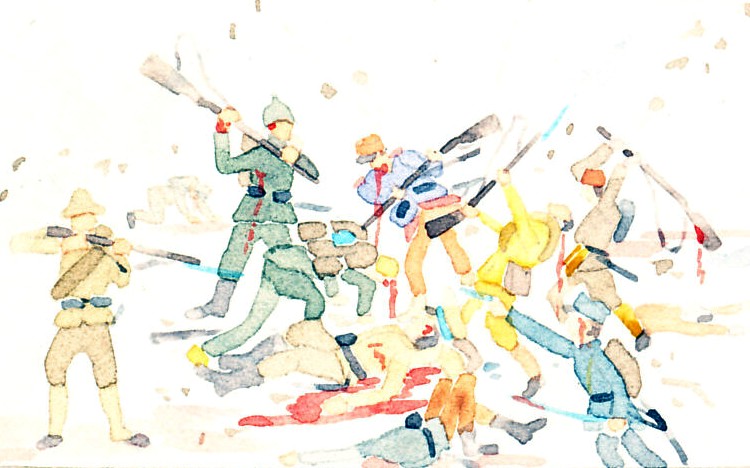
German troops feeding hungry Russians as if they were livestock. The Russians have dropped what weapons they have. Russian soldiers were under-supplied, and, as Russia, Germany, and Austria-Hungary battled across their land, Russian civilians were displaced, homeless, and starving.
Der Weltkrieg 1914. No. 12.Von der russischen Grenze: Täglich Fütterung sämtlicher RaubtiereThe World War 1914. No. 12.From the Russian border: daily feeding of all the beastsReverse:Albert Ebner Kunstanstalt, MünchenAlbert Ebner Art Institute, Munich
"All this time, from December, 1916 to February, 1917, the Russian front was comparatively quiet, furious snowstorms preventing the advance either of our own or the enemy's forces. Alas! The storms interfered also with railroad transport and Petrograd and Moscow were beginning to feel the pinch of hunger, a fact that gave their Majesties constant concern."
Extract from the memoir of Anna Viroubova, confidant to the Empress Alexandra, and one of the few people, other than Rasputin, the Empress associated with. Viroubova writes that Tsar Nicholas was engrossed in planning spring offensives. Petrograd, the capital, and Moscow were the two most important cities in the Russian Empire.
Memories of the Russian Court by Anna Viroubova, page 196, copyright © 1923 by The MacMillan Company, publisher: The MacMillan Company, publication date: 1923
1917-01-07, 1917, January, February, food, food shortage, Moscow, Petrograd, famine, starvation, hunger